By Outrank
10 Directory Submission Tools for SaaS Launches
Compare 10 directory submission tools for SaaS and startup launches, from self-serve platforms to done-for-you services, with pricing and limits.
On this page
A hundred directory submissions do not produce a hundred visitors. Most produce a page nobody links to, an approval email that never arrives, and a product description you rewrote forty times by hand. The gap between a wasted month and a launch that keeps compounding comes down to two things: whether the directory fits the product, and whether you can verify the work landed.
The tools below fall into four groups, and the group tells you more than the feature list does. Self-serve catalogs hand you the list and the forms. Assisted form-filling adds a browser extension that retypes your details into each field. Done-for-you services file the forms for money. Single-destination directories place your product in one curated index and stop there.
Every entry is judged on three things you can verify: a live listing URL, the badge and login requirements the directory imposes, and the approval limits the tool admits to in writing. Not Domain Rating lifts promised in a hero section, and not "high-authority backlinks" with no names attached to them.
You'll leave with a ranked shortlist and an order to file it in, not a longer list of links.
1. SubmitMySaas
Most launch platforms ask you to pick a Monday and hope. SubmitMySaas runs a weekly ladder instead, and that structure is why a product launch belongs here before any multi-directory package gets paid for. It's a community-driven launch and discovery platform for SaaS, AI, productivity, marketing and design tools, and products enter through daily launches, trending lists and monthly roundups rather than one static category page.
The catalogue is deep enough for a category to mean something. The Top Categories section lists 268 projects under Artificial Intelligence, 268 under SaaS, 191 under Productivity, 112 under Marketing Tools and 61 under Design Tools, so a niche tool isn't competing against everything in the index at once.
How the launch ladder works
Two routes, one of them free. The free launch sits in the standard queue, with 10 free slots available each week, and it comes with a condition founders routinely miss: the dofollow backlink lands only if the product finishes in the top 3 of the weekly ranking and displays the SubmitMySaas badge on its own site. Install that snippet before launch day, not after the win, or the placement arrives without the link.
Premium Launch costs $19 per launch, skips the free queue for priority placement in an available Monday slot, adds priority weekly placement and a homepage feature, and includes a guaranteed high authority dofollow backlink. There's no platform-wide weekly cap on premium slots, so a busy week doesn't push you out.
What the rankings actually reward
Top Projects ranks 10 products each week, and This Month's Best lists 5, which means the site produces fresh surfaces after launch day instead of burying you in an archive. A paid featured package adds a badge plus 35+ DR backlinks across the network. If you want a standing slot rather than a launch spike, advertising costs $79 per product for a month.
What it does not do: the placement and the backlinks buy discovery and credibility. They don't buy traffic, signups or a ranking, and any listing that promises those is selling a lottery ticket with your logo on it.
2. Submitator
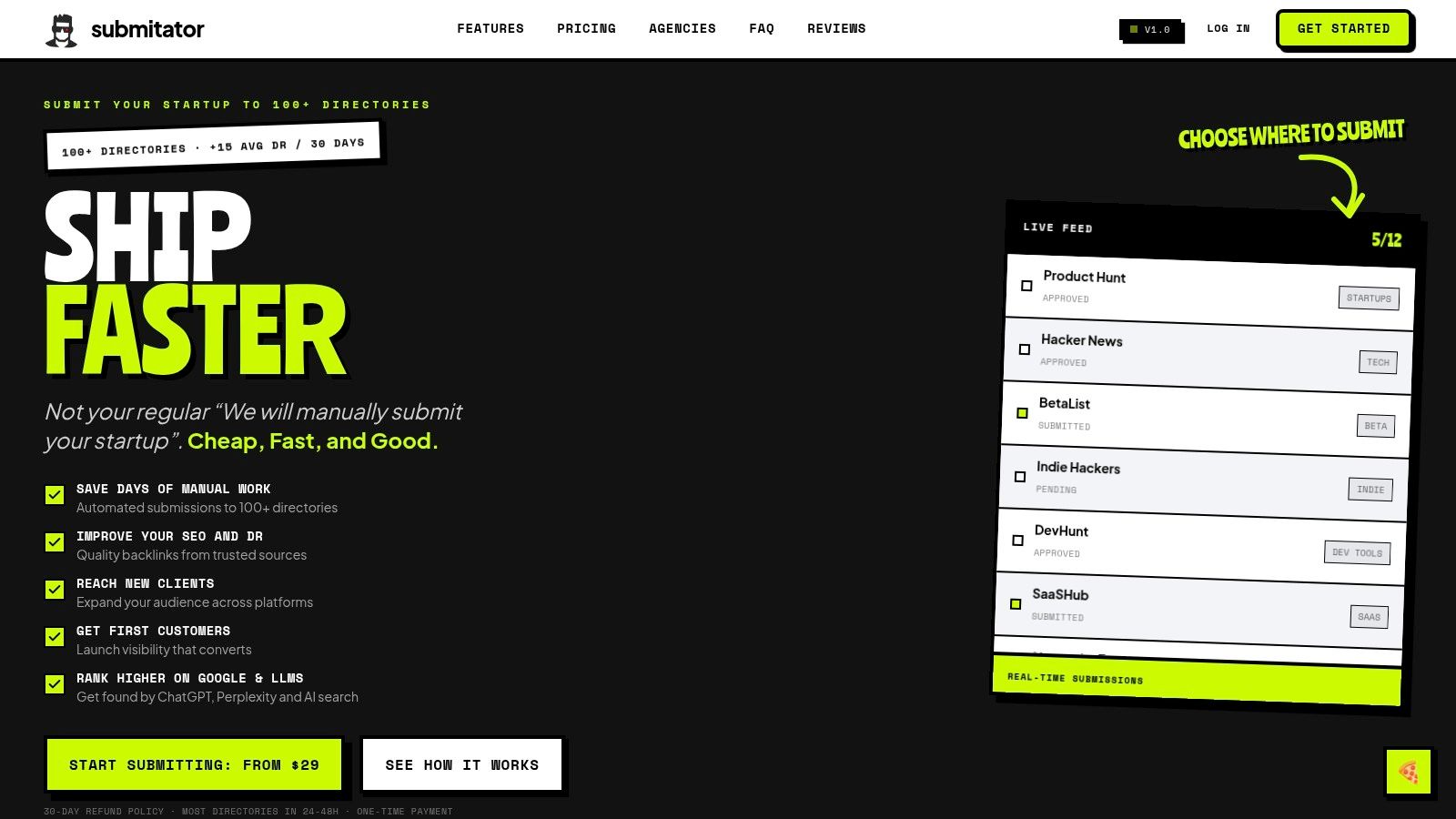
Submitator is a spreadsheet with a robot attached, and that's a compliment. You enter product details once into a reusable, editable profile, then choose a subset of its 170+ directory catalogue or hand over the lot. A dashboard tracks status per directory and the final report returns the submission links, so you aren't trusting a screenshot with a timestamp.
Here's the working view of that console.
Where it stalls
Badge handling is real work. Submitator can manage directories that demand a badge on your site, which means a component goes live on your domain and has to stay there. A submission is not an approval. The vendor says rejected submissions are credited toward a replacement selection, and you should hold them to it with the report in hand. Directory counts and turnaround figures are vendor-reported, so treat them as intentions rather than delivery records.
One-time plans make the cost easy to budget, and choosing your own targets gives you more control than a black-box service ever will. Breadth still has a case: in 2024, 77% of consumers used at least two review platforms when researching a business, according to BrightLocal's Local Consumer Review Survey, and the same scatter applies to how buyers find software. Spread presence, but verify every listing.
3. Submit a Tool
Submit a Tool is built for people who won't pay for work they can do themselves. The manual checklist and directory list are free, and a browser extension saves your product fields, then matches them to each form's labels by meaning rather than by exact field name. That one design choice saves more time than any bulk-submit button.
The paid side is where it gets interesting. Credits are charged for completed submissions, not form fills or failed attempts, and every CAPTCHA and login step gets handed back to you rather than bypassed.
A credit that only bills on completion changes behaviour. You stop avoiding the directories with the three-step email verification, because failing costs nothing.
What it won't do for you
The extension can't finish every directory's process, and done-for-you submissions aren't open yet, so this stays a self-serve tool. Approval and listing timelines vary by directory, which is the same sentence every honest vendor writes and every dishonest one omits. Its tracking layer checks for a listing link after submission, which is the only feature here that separates a tool from a to-do list. Budget for a dedicated submissions inbox before you start, because confirmation emails will bury your normal one.
4. SubmitI
SubmitI sells context before it sells submissions, and that ordering is right. Its database shows each directory's submission type and login requirements before you commit, and matching leans on your product positioning and each directory's niche instead of a flat alphabetical list. The tracking layer records status, link attributes and proof, which answers the dofollow question without you opening every page by hand.
Why link attributes deserve their own column
The reason a link attribute column matters goes back to the original ranking model. Stanford researchers Larry Page and Sergey Brin built PageRank on the idea that a page ranks when important pages link to it, testing the approach on a dataset of roughly 24 million web pages, as the National Science Foundation's account of the work records. A listing inside a curated, crawlable category is a different object from a footer link on a link farm, and the tool is right to show you which one you're buying.
Two things to check before paying. Some matched results only appear after you create a task, so you can't audit the whole target list upfront. Packages are credit-based, which means the value depends entirely on which targets the credits reach. It states plainly that it avoids link farms, PBNs and fake-profile blasts, and it doesn't guarantee rankings, indexing or dofollow links, which is the correct scope for a discovery service.
5. Submi
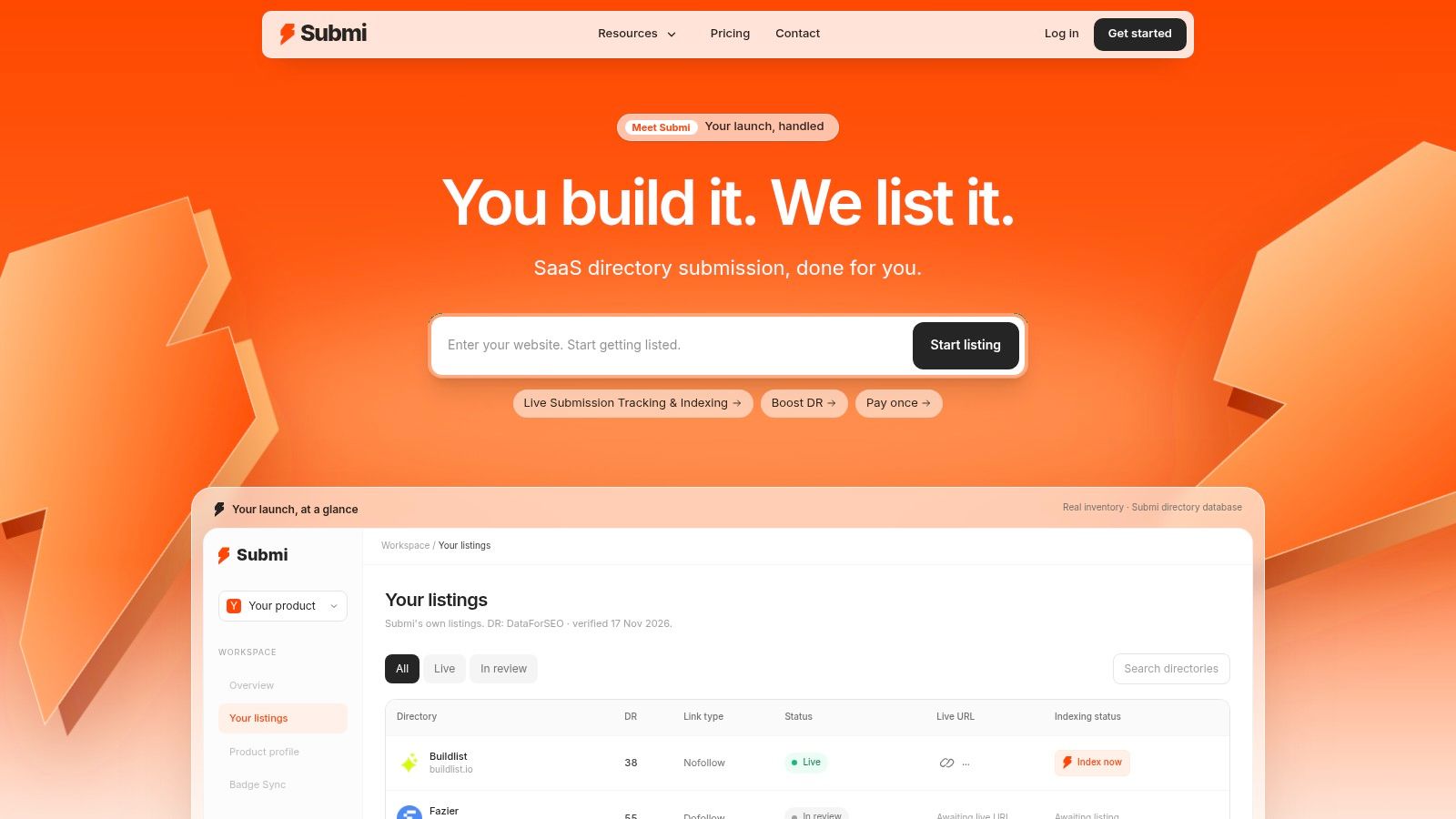
Submi's dashboard carries the one column most competitors skip: live listing URLs. Submitted and in-review are separated from live, which is the difference between a month of work and a month of receipts. Your product profile is drafted for review before submissions begin, so a wrong category or a stale pricing line doesn't get filed ninety times.
The interface looks like this.
That verification focus is worth more than it sounds. A BrightLocal study of 8,000 Google organic results, drawn from local-intent searches, found business directories made up 31% of all top-10 organic results. The transferable lesson for a SaaS listing is that indexed, complete profiles earn visibility as secondary search surfaces, while half-finished ones earn nothing. Treat each listing as a page you're optimizing, not a citation you're banking.
The trade-offs
Badge Sync handles directories that require a snippet, though you still install it where their rules say you must. Indexing tools and listing tracking are included, and plans are one-time rather than subscription. The higher-priced tier can be more than an early-stage project needs, and directory moderation and indexing timelines sit outside anyone's control at the vendor. Expect some listings to sit in review for weeks.
6. SubmitSaaS
SubmitSaaS is the straightforward version of done-for-you: fixed tiers of 60+, 100+ or 140+ directory submissions, one payment, a report at the end, and a stated 48-hour turnaround. You can hand over a dedicated submission email with credentials, so confirmations and moderator replies never touch your main inbox. It also publishes free directory research and calculators, which is more than most sellers of form-filling offer.
The number on the package is submissions, and that distinction is expensive. Google's search spam policies list low-quality directory or bookmark site links as a link-spam example, and warn that when spam systems neutralise problematic links, previous ranking benefit may not return. A package promising a Domain Rating lift is describing a target it doesn't control.
Ask any done-for-you service one question before paying: how many of these directories do you expect to reject me, and what happens to my money when they do.
Directory approvals take days, weeks or months depending on the queue, so the 48-hour clock covers filing, not publication. The vendor says listings are created with customer ownership in mind, and you should confirm you receive the logins so you can edit a listing later. The stated tiers are the honest part. The DR claims are the part to ignore.
7. SaaSLyft
Most services paste the same sixty-word blurb into every form. SaaSLyft writes listing copy per directory, which is slower and better, and it's upfront about the queue: work usually begins 3 to 6 business days after your details and payment arrive. This is a manual service, not an app, so don't expect to watch a progress bar move.
Proof you can file
Reports come back with URLs, screenshots and statuses, which is what makes the work checkable months later when a listing disappears. Directory selection is based on product fit and stated quality criteria rather than a fixed bundle, and there's follow-up or replacement when a directory turns out to be unsuitable or unavailable. The service distinguishes a submission from an approval, which is the single most important sentence in this whole category.
Two costs to plan for. Some optional listing or fast-track fees are billed separately by the directories themselves, so ask which ones before work starts. And because the work is manual and customized, it doesn't suit a founder who needs forty listings live by Friday. If your positioning is unusual, that customization is worth the wait. If your product is a generic utility, it's money spent on poetry.
8. FreeSaaSDirectories
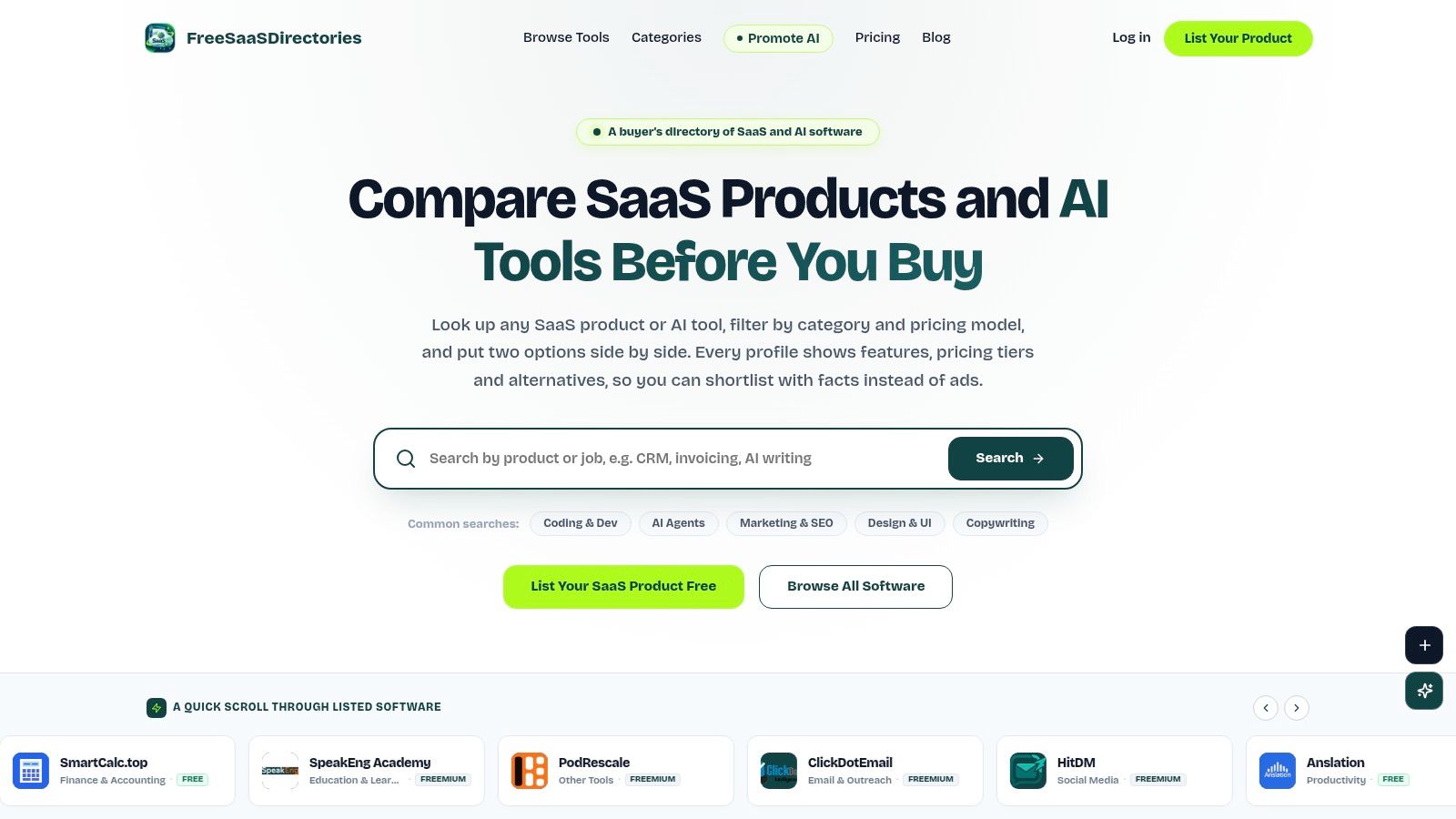
FreeSaaSDirectories sits at the budget end of hand submission, and the useful part is the housekeeping nobody advertises: it checks for existing listings and duplicate submissions before filing, and replaces rejected directories according to its pricing page. Reports list the directories alongside the live links, which is the minimum for making the work auditable.
The entries look like this.
Keep the price in perspective
In a 2024 survey of 113 SEO professionals across the United States, Europe and the United Kingdom, 53.9% reported spending more than $300 to acquire a single quality backlink, according to Editorial.Link's survey summary. A cheap package that clears a dozen indexed listings and one good editorial link are different purchases, and both are legitimate ways to spend the budget.
The caveats are the same as everywhere in this tier. Manual submission handles odd forms well, but a package count doesn't guarantee approval or indexing. Directory quality and audience fit still need your own check, and the provider's link-metric claims deserve independent verification before you quote them to a board.
9. SubmitStartup
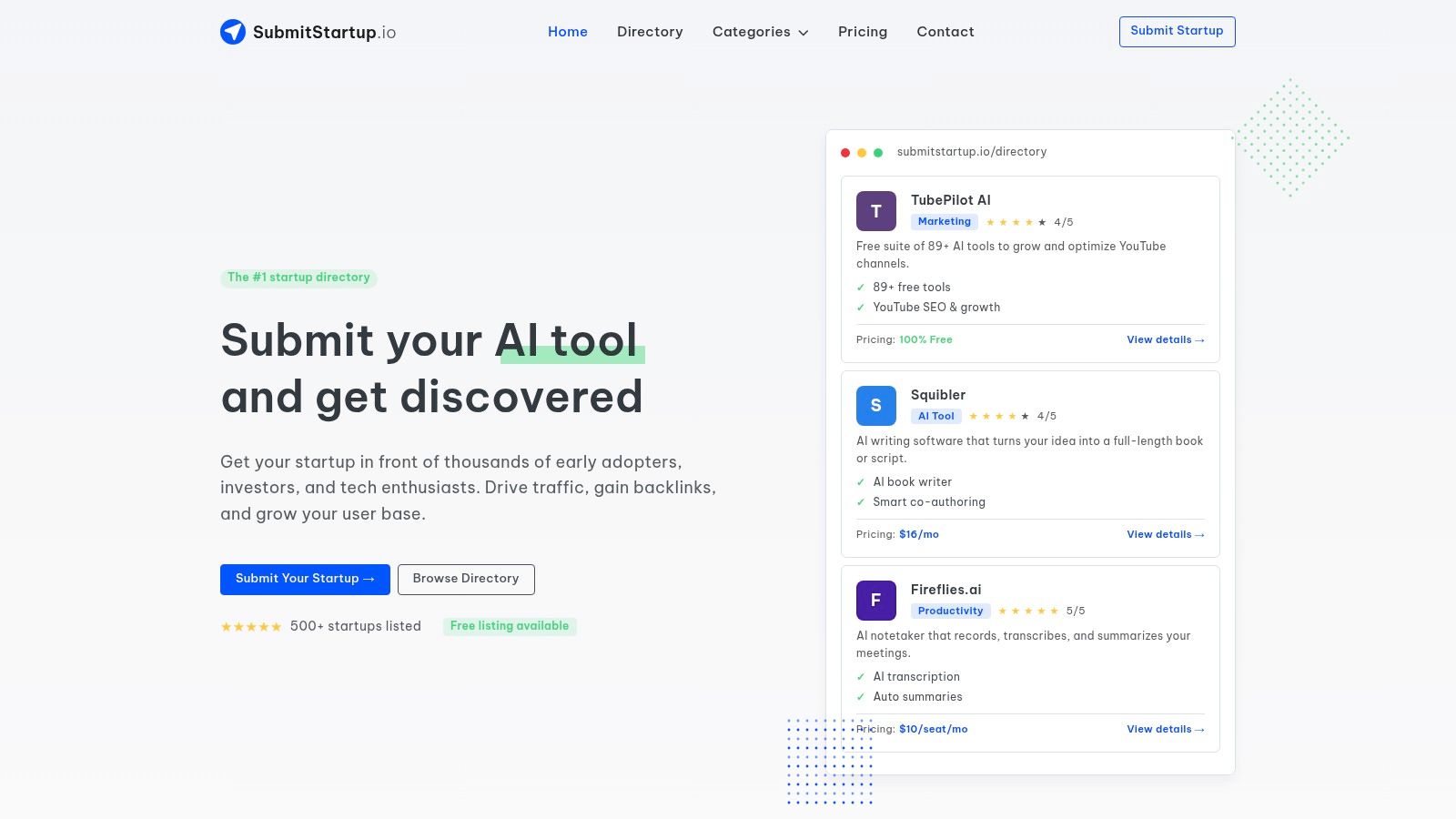
SubmitStartup does two jobs, and it's worth being clear which one you're buying. A free listing on its own directory costs nothing and lets you test the platform and its review process. The premium bundle submits your product by hand to five selected directories, with categories for SaaS, AI and other tech products. Five is a small package, clearly described.
The interface is plain by design.
The history lesson behind single destinations
Relying on one index has a long track record, and not all of it is good. Stanford students Jerry Yang and David Filo created the guide that became Yahoo's directory in January 1994, and by early 1995 the catalogue reportedly held about 10,000 sites with more than 100,000 visitors per day, according to Jasmine Directory's history of web directories. Yahoo retired its directory at the end of 2014, and DMOZ closed in March 2017 after nearly 19 years of volunteer editing.
One destination is a channel, not a moat. Take the free listing, keep your own copy of the description and the screenshot, and don't build a launch plan that depends on a review queue you can't see. Claims about backlinks and exposure on a five-directory bundle are not independent performance evidence, and publication always depends on the directory, not the seller.
10. SaaSDatabase
SaaSDatabase is less a submission tool than a publishing deal, so judge it as one. The free standard submission puts you in a long queue at no cost. The paid Get Published package includes a listing written and published by the provider plus a 1,000+ word feature article, with expedited review compared with the standard queue and one-time pricing instead of a recurring listing subscription.
That makes verification simple. The deliverable is a live article URL on one domain: either it exists or it doesn't.
Where editorial coverage earns its keep
An article gives a product context a forty-word directory card can't: the problem, the workflow, the trade-offs. That's useful when a buyer is comparing three tools and needs a reason, and it's useful when a machine is deciding which page to cite. The AI-visibility case needs accurate numbers, though. A study of 391 small and medium-sized business websites found referral traffic from generative AI more than doubled between September 2024 and February 2025, from 0.54% to 1.24% of organic traffic, as Search Engine Land reported.
One article on one domain is a citation candidate, not a distribution channel.
That's the honest framing. Paid coverage here sits on SaaSDatabase alone, not across a bundle of independent directories, so it doesn't replace a submission campaign. A feature article or a backlink doesn't guarantee leads or rankings either. Buy it for the context and the credibility signal, then measure branded search and referral sessions for ninety days before deciding it worked.
Directory Submission Tools Compared
The useful sort is labor left after checkout. Self-serve forms keep control but leave every field to you; extensions and trackers cut repetition; done-for-you packages move the typing to a vendor; single destinations trade reach for one accountable page.
| Item | Work left for you | Plan Type | Best For | Main Limitation |
|---|---|---|---|---|
| SubmitMySaas | Submit one project to a weekly launch and category lists | Free Launch at $0 with 10 free slots weekly; Premium Launch at $19 per launch; advertising at $79 per product per month | Makers seeking launch exposure and directory discovery | Free dofollow requires a weekly top-3 finish and the badge; exposure does not guarantee traffic |
| Submitator | Directory submissions managed through a dashboard | One-time plans | Teams seeking broad submissions with progress tracking | Approval or publication is not guaranteed |
| Submit a Tool | Browser extension for manual or supported auto-submissions | Free manual tools; paid credits for completed submissions | Founders who want to manage submissions themselves | Automation does not work for every directory |
| SubmitI | Directory matching, submission tracking, and proof records | One-time, credit-based packages | Users who want to vet targets and verify submission work | Packages require checking which targets are included |
| Submi | Managed SaaS directory submissions with listing tracking | One-time plans | Teams seeking reviewable profiles and live-listing records | Moderation and indexing timelines are outside its control |
| SubmitSaaS | Done-for-you directory submissions with a report | One-time packages | Founders who want to outsource repetitive submission work | Submission counts do not guarantee live listings |
| SaaSLyft | Manual submissions with tailored copy and reporting | Service packages; some optional fees may apply | Products needing careful positioning across directories | Not an instant self-serve service |
| FreeSaaSDirectories | Hand-submission service with reports | Paid packages | Budget-conscious founders seeking done-for-you submissions | Package counts do not guarantee approval or indexing |
| SubmitStartup | Own-directory listing plus a small hand-crafted submission bundle | Free listing and paid options | Teams seeking a platform listing and submissions to selected directories | Bundle covers only five directories |
| SaaSDatabase | Submission to its directory, with optional editorial coverage | Free standard option and one-time paid package | Teams seeking an editorial-style listing and feature article | Paid coverage is limited to its own platform |
I'd judge every row by the artifact it can hand back: a live URL, an approval note, a dated report, or only a submission count. Counts are inputs; live pages are receipts.
Sequencing Your Submissions So the Effort Pays Off
Order beats volume. File two or three high-fit self-serve directories by hand first, before any money changes hands, because the first three forms will expose every weakness in your product copy: the one-line pitch that's too long, the category that doesn't exist, the pricing field that forces a number you don't charge. Fix those once and every later submission gets faster.
Only then add a browser extension to handle the repetitive fields, and use it for a week before trusting it with a batch. Once the manual loop is understood and the copy is stable, buy a done-for-you package strictly for the long tail of forms that would otherwise sit unfiled forever. Paying someone to file the first five directories is paying to learn nothing.
A verification loop that takes ten minutes per listing
- Save the live listing URL, not the submission confirmation. The URL is the proof, and the confirmation is a promise.
- Screenshot the confirmation page on the day it appears, with the date visible, so a later removal has a paper trail.
- Record dofollow or nofollow by viewing the rendered page source, since a listing page can change attribute without telling anyone.
- Install the badge snippet wherever the directory's rules require it, and confirm it renders rather than trusting the deploy log.
- Recheck at 30 and 90 days. Listings get pruned, domains lapse and categories get rebuilt, and the only way to know is to look.
Be realistic about timing. Approvals can take weeks, some directories never reply at all, and no package on this list guarantees indexing, let alone traffic. What a good vendor gives you is a record you can audit and a replacement when something is rejected.
The cost benchmark worth memorising
Use a known ladder as your anchor before you compare any package. SubmitMySaas prices a Free Launch at $0 with 10 free slots each week, and a Premium Launch at $19 per launch with priority placement and a guaranteed high-authority dofollow backlink included. Set a $99 package of thirty submissions against that. If a third of them clear moderation, you've paid roughly ten dollars per live listing on directories you didn't choose, on pages that may never be indexed, for a link you can't verify without hunting each one down.
Run the same division on every quote you receive, and ask which directories are named in the package before you pay rather than reading the list in the report afterward.
SubmitMySaas puts your launch in front of an audience already browsing new SaaS and AI tools, with a free weekly slot or a $19 Premium Launch that includes priority placement and a guaranteed high-authority dofollow backlink. File the hand-worked directories first, sharpen the pitch, then give the launch a real shot at the weekly rankings where the badge and the link are earned. When you're ready to stop filling forms and start getting discovered, submit your product to SubmitMySaas and pick the Monday that fits your build.