By Outrank
Best Day for Product Launch: Data-Backed Timing by Goal
Find the best day for product launch by goal: Tuesday to Thursday for reach, Monday for ranking, and how to test timing with real launch data.

On this page
Tuesday through Thursday is the default launch window for most B2B SaaS and AI products, because that's when professional buyers are at their desks and your team can answer them. The exception is goal-driven: if ranking difficulty is your real constraint, Monday needs fewer points to reach a launch platform's top five than Wednesday does, and Saturday needs fewer still.
The catch nobody puts in the headline is that attention and competition rise together. In PH Launch Pad's day picker analysis of Product Hunt launches from March 2025 to March 2026, weekday activity averaged 9.5 launches per day against 6.0 on weekend days, a 58.3% higher weekday rate. So the day with the most readers is also the day with the most rivals sitting directly above and below you on the page. Picking a launch day isn't a hunt for a magic date. It's a decision about which shortage you can tolerate: fewer eyeballs, or a harder fight for them.
Launch Day by Goal at a Glance
Start with the outcome you need, not the calendar. A day that maximizes attention can also be the day your product is hardest to find, and those two effects don't cancel out neatly. They trade against each other, and the exchange rate depends on what you're counting as success.
Use the table as a lookup. Find your primary goal in the first column, read the day, then read the trade-off column before you commit to a date. The trade-off is the part most founders skip, and it's the part that determines whether the launch felt good or worked.
Best launch day by goal
| Goal | Best day | Why it works | Trade-off |
|---|---|---|---|
| Broad reach and press attention | Tuesday | Busiest weekday for launches, when most people check feeds | Crowded day, harder to stand out |
| Lower competition and easier ranking | Monday | Fewer median points needed to reach the top five than on Wednesday | Smaller audience on the day |
| Lowest competition on any day | Saturday | Lowest median points needed to enter the top five | Far lighter launch volume than Tuesday, so less absolute reach |
| Trial starts and signups | Tuesday or Thursday | Email and sales follow-up happen during working hours | Requires same-day support coverage |
| Highest chance of 10+ upvotes | Friday | Highest probability of reaching 10 or more upvotes, 6.5%, in LaunchLlama's launch-day analysis | Email opens are more moderate than midweek |
| Global audience | Primary market's business hours | Local activity peaks late morning to late afternoon | Other regions launch off-hours unless staggered |
How to read the trade-off column
Each row asks you to give something up. Tuesday buys you a full inbox of active buyers and charges you in visibility, because everyone else picked Tuesday too. Monday and Saturday buy you a cleaner leaderboard and charge you in raw reach, comments, and downstream traffic.
Notice that the goals aren't interchangeable. Votes, ranking, click-throughs, trial starts and press coverage are five different scoreboards, and a day that wins one can lose another. A founder chasing a category badge and a founder chasing 40 activated trials should not book the same slot, even with identical products.
Practical rule: pick one primary goal and one fallback day before you book anything. If your primary is trial starts and your fallback is Monday, you've already decided that reach matters more than ranking, and you won't renegotiate with yourself at midnight.
For the wider volume picture behind these rows, our launch statistics research collects the platform-level numbers in one place. Write your goal down in a single sentence, in the form "this launch succeeds if X happens", and the day choice gets much easier.
Why Tuesday to Thursday Is the Default for B2B Launches
The clearest signal for the workweek comes from email behavior, not from launch leaderboards, and it's worth being precise about that. Twilio's 2023 Email Marketing Benchmark Report recorded median sends of 46,727 on Tuesday, 45,482 on Wednesday and 47,386 on Thursday, against 32,550 on Saturday and 29,759 on Sunday. Those are email-campaign proxies, measuring where senders concentrate their volume, not launch outcomes.
The same report put Thursday at the highest 75th-percentile send volume, 69,454, narrowly ahead of Friday's 69,068, and found the workweek produced the strongest engagement overall while Monday carried the highest open rate among weekdays. Read that as a map of where professional attention lives, then apply it to launches by analogy rather than by proof.

The mechanism is operational, not mystical
A shop opens when the street is busy, not when the rent is cheaper. Launch timing works the same way, and the reason has three parts that all involve people rather than algorithms:
- Buyers are reachable. A procurement lead or head of marketing scanning tools at 11am on Wednesday can click, sign up and forward your link to a colleague in the same sitting. On Saturday that same person is offline, and your listing ages two days before they see it.
- Your team can respond. Support, engineering and the founder are all awake and at a keyboard. A broken signup flow gets fixed in 20 minutes instead of surfacing in Monday's inbox as 60 lost trials.
- The week still has runway. A Tuesday launch leaves three working days for follow-up email, demo bookings and press replies. A Friday launch spends its follow-up window on a weekend.
What that looks like in practice
Say a two-person team ships a B2B project management tool on Tuesday morning. By 2pm they've had four replies from agency owners, one asking about SSO, and they've answered all four before the day ends. Two of those threads become demos on Thursday.
Run the identical launch on Saturday and the same four replies arrive Monday morning, mixed into a full inbox, from people who half-remember seeing the product two days ago. Nothing about the product changed. The response latency did, and latency is what kills warm interest.
The workweek is a defensible default for SaaS, not a proof that Thursday always wins. Consumer tools, developer hobbies and weekend-project products can behave differently, and category competition varies by day. Check your own audience before you treat the default as a rule.
When Monday or Weekend Launches Make Ranking Easier
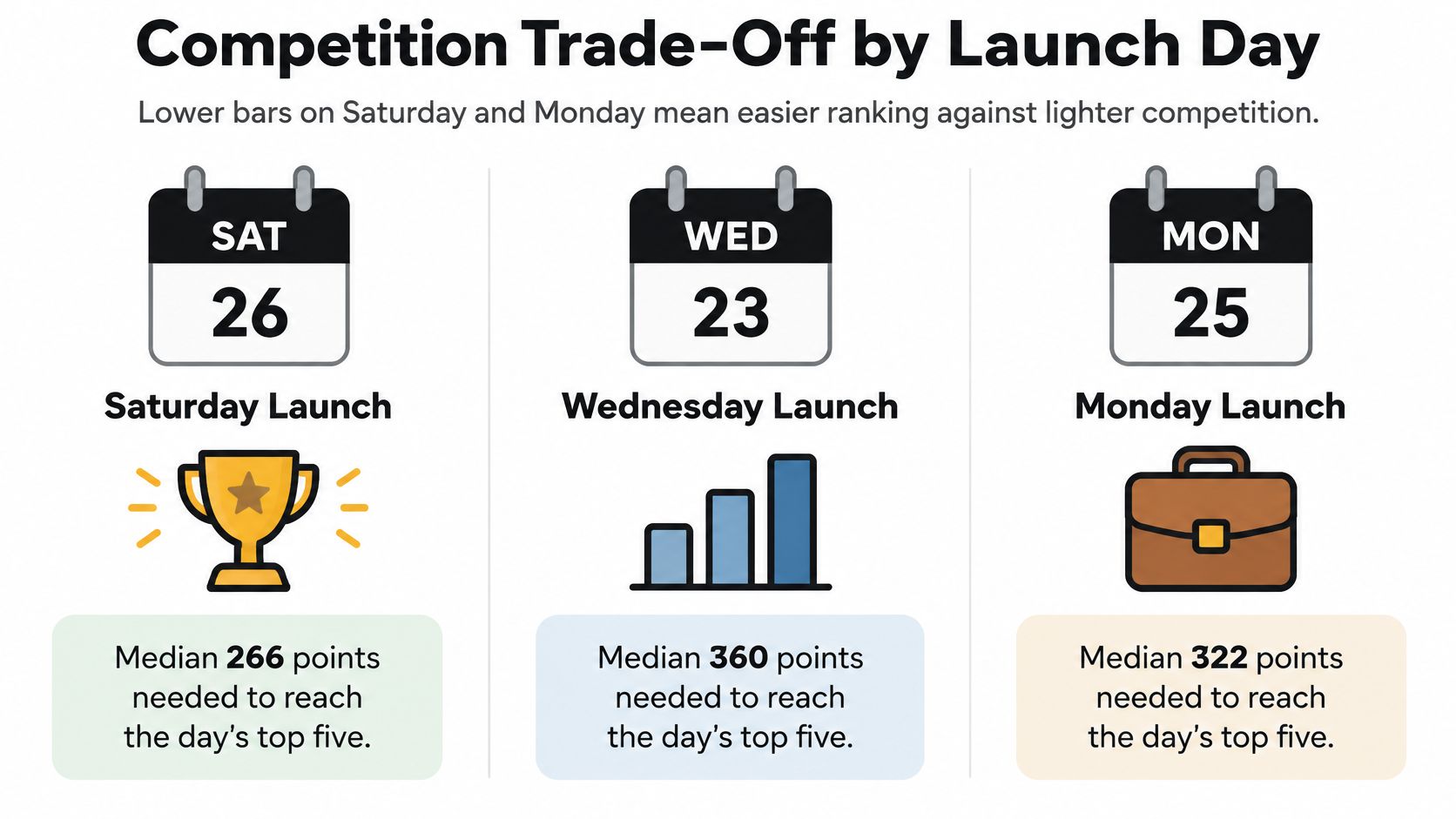
Choose a quieter launch day when leaderboard placement matters more than maximum exposure. The useful comparison is the points threshold you can realistically reach, rather than the day with the most activity.
Product Hunt competition by launch day
| Day | Median points to top five |
|---|---|
| Saturday | 266 |
| Monday | 322 |
| Wednesday | 360 |
The 2026 analysis of Product Hunt launches published on the platform reported Saturday required a median of 266 points to enter the day's top five, against 360 on Wednesday, with Monday at 322 median points and Saturday carrying roughly three times fewer launches than Tuesday. Monday was therefore an easier target than Wednesday among the weekdays with published medians, not a proven winner across every weekday.
Tuesday averaged 1,512 launches per day across four weeks tracking 34,230 launches, according to Nicheloom's 2026 product launch statistics. Launch volume measures how crowded a day is; it does not establish how many relevant buyers will see your listing.
Two strategies, two different founders
A solo developer with a small newsletter and no press contacts may prioritize a top-five finish. A quieter day offers a lower observed threshold, making limited distribution more competitive. The trade-off is accepting potentially less exposure in exchange for a more attainable ranking.
That choice still needs a business outcome. A badge or landing-page screenshot can support credibility, but assess whether the launch cohort also produces useful feedback and signups. A high rank alone does not establish audience fit.
A funded team with partner newsletters, press outreach and a founder following has a different calculation. Its own distribution may support a more competitive launch day. Choose that day when the audience you want is reachable, rather than assuming heavier launch volume guarantees more journalists, investors or customers.
Accept more competition when your distribution can support it and the audience is relevant. Accept less exposure when ranking is the more useful outcome.
Where a Monday slot actually exists
Platform schedules determine which choices are available. On SubmitMySaas, weekly launches start every Monday at 8:00 AM UTC, and all products scheduled for that week go live together. Founders publish product pages, join a launch cohort, and receive community votes and comments.
The Free Launch plan has 10 free slots available each week, so free availability is limited, rather than the entire Monday cohort being capped.
Treat the Product Hunt medians as directional benchmarks, not predictions for another platform. Choose the trade-off your resources can cover, then judge the cohort by relevant engagement alongside its ranking.
Plan Launch Timing for a Global Audience
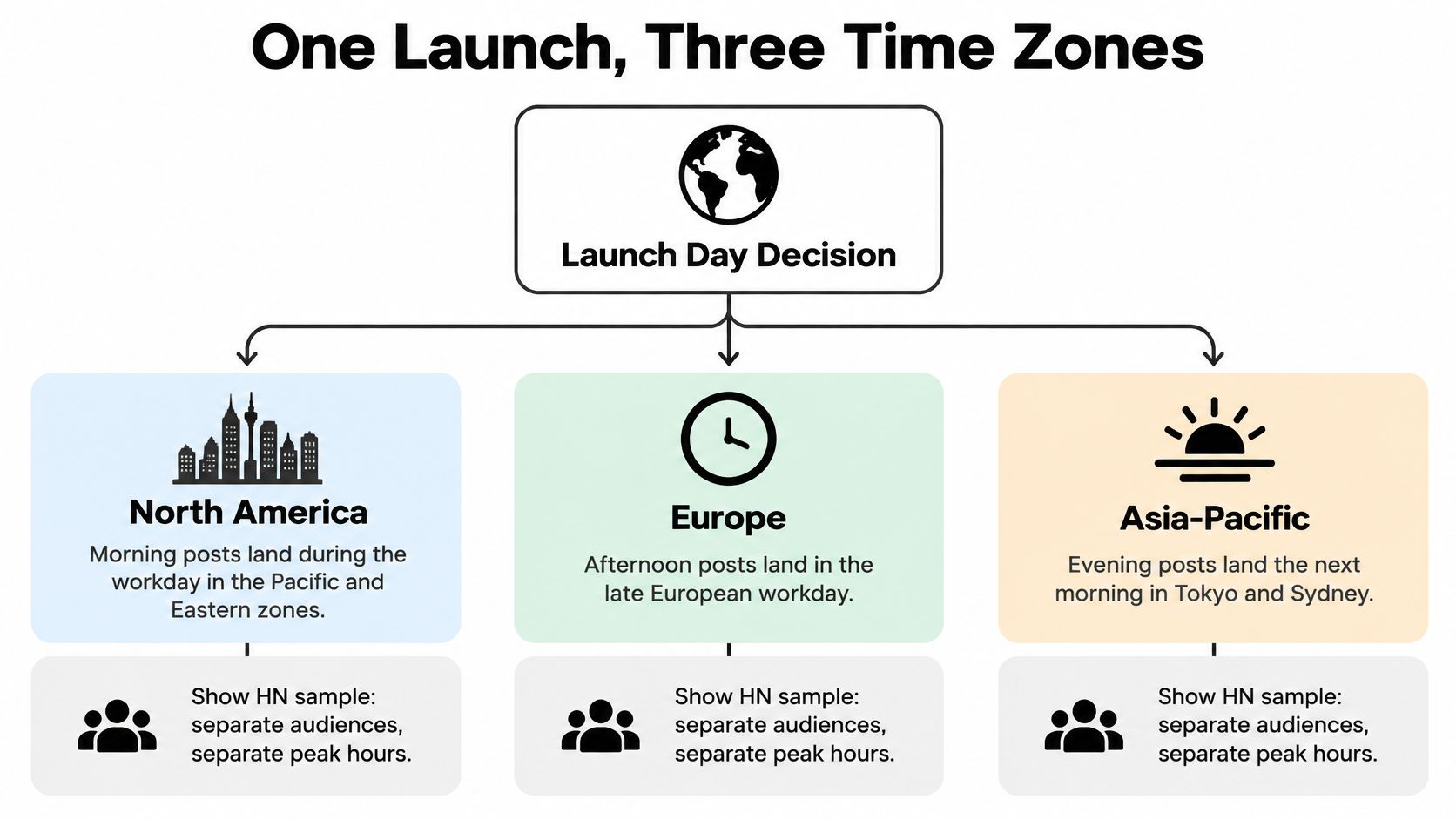
Most day-of-week advice assumes you have one audience in one time zone. SaaS and AI products rarely do. A developer tool with paying customers in Berlin, Toronto and Singapore has three working days happening in sequence, and a single timestamp lands in the middle of one of them and the dead hours of the others.
The weekday effect is also weaker than the confident headlines imply on some platforms. On those platforms, the difference in how often posts reach 10 or more points across weekdays is small, so picking Tuesday alone buys you very little. Channel timing matters more than the date, and social engagement peaks Tuesday or Wednesday from late morning to late afternoon in the audience's local time, based on an analysis of roughly 2 billion engagements from about 307,000 social profiles in Emulent's social timing research.
Publish once, amplify in waves
The fix is to separate the publication timestamp from the promotion schedule. Your product page goes live once. Your emails, social posts and community messages go out several times, each timed to a region's own late morning.
Consider a team whose revenue is mostly North American while its support desk sits in Europe. They publish for the start of the US business day, when their buyers are opening laptops, and let the European team handle the overnight comment queue as their own morning begins. Then they schedule a second social wave timed to European late morning and a third for Asia-Pacific. Blasting all three regions at 9am Pacific would waste two of them.
Three questions settle the schedule:
- Where does revenue come from? Publish for the market that pays you, not the market where you happen to live.
- Who is awake to answer? If support coverage is European, a US-afternoon publish leaves questions unanswered for hours. Shift the hour or shift the coverage.
- Which channel carries the launch? Directory discovery, founder outreach and website conversion peak at different hours, so a directory listing can go live early while outreach waits for inboxes to be watched.
Notice what this means for the goal decision. Once promotion is spread across time zones, the publication timestamp stops being a reach decision at all. It becomes a coverage decision, and the right hour is the one where someone on your team can respond.
Don't force every audience into one timestamp. Force every audience into its own working morning, and let the listing sit quietly in between.
How to Schedule Launch Actions Within the Day
Once the day is chosen, the hour sequence does most of the work. Brevo's send-time analysis reports that weekdays generate more than 85% of weekly email opens and nearly 95% of weekly clicks, and recommends 10:00 to 15:00 for Tuesday and Thursday sends. That gives you a spine for the day: publish early, email mid-morning, amplify after lunch.
Run the launch in this order.
- Publish the product page in the morning. On SubmitMySaas, founders publish product pages, join a launch cohort, and receive community votes and comments, so an early publish gives the listing a full working day to accumulate both. A page that goes live at 4pm has three hours of attention and then competes with dinner.
- Activate founder and partner email at roughly 10:00 to 11:00. Midweek recipients are at their desks and can act on the message immediately, which is the difference between a click and a bookmark. Send plain text from a real person's address, and put the product link above the fold of the email.
- Reserve 12:00 to 15:00 for social amplification and demo-driven calls to action. People scroll after lunch, and a short screen recording with a "book a 15-minute demo" link converts that idle attention better than a feature list.
- Keep the team online through the afternoon. Watch uptime, the signup funnel and the comment thread, because a launch has several remaining weekdays to recover from problems only if someone notices the problem on day one.
Prepare the assets before the clock starts
The sequence collapses if you're writing copy at 10:05. Draft the launch email, the first comment, three social variants and the answers to your five most likely objections the week before, and store them where anyone on the team can paste them. Our product launch timeline lays out that preparation week by week.
Release hygiene matters just as much as messaging. If your launch includes a mobile build, the review and rollout steps need their own buffer, and this walkthrough of the mobile app release process helps you reduce wasted release-cycle hours so a store delay doesn't swallow your launch morning.
Treat 10:00 to 15:00 as a starting prior, not a law. Segment your results by geography, device and acquisition channel, and check activation and seven-day retention rather than opens. Then alternate comparable launches between Tuesday and Thursday and let your own funnel overrule the benchmark.
Test Your Launch Day and Measure the Result
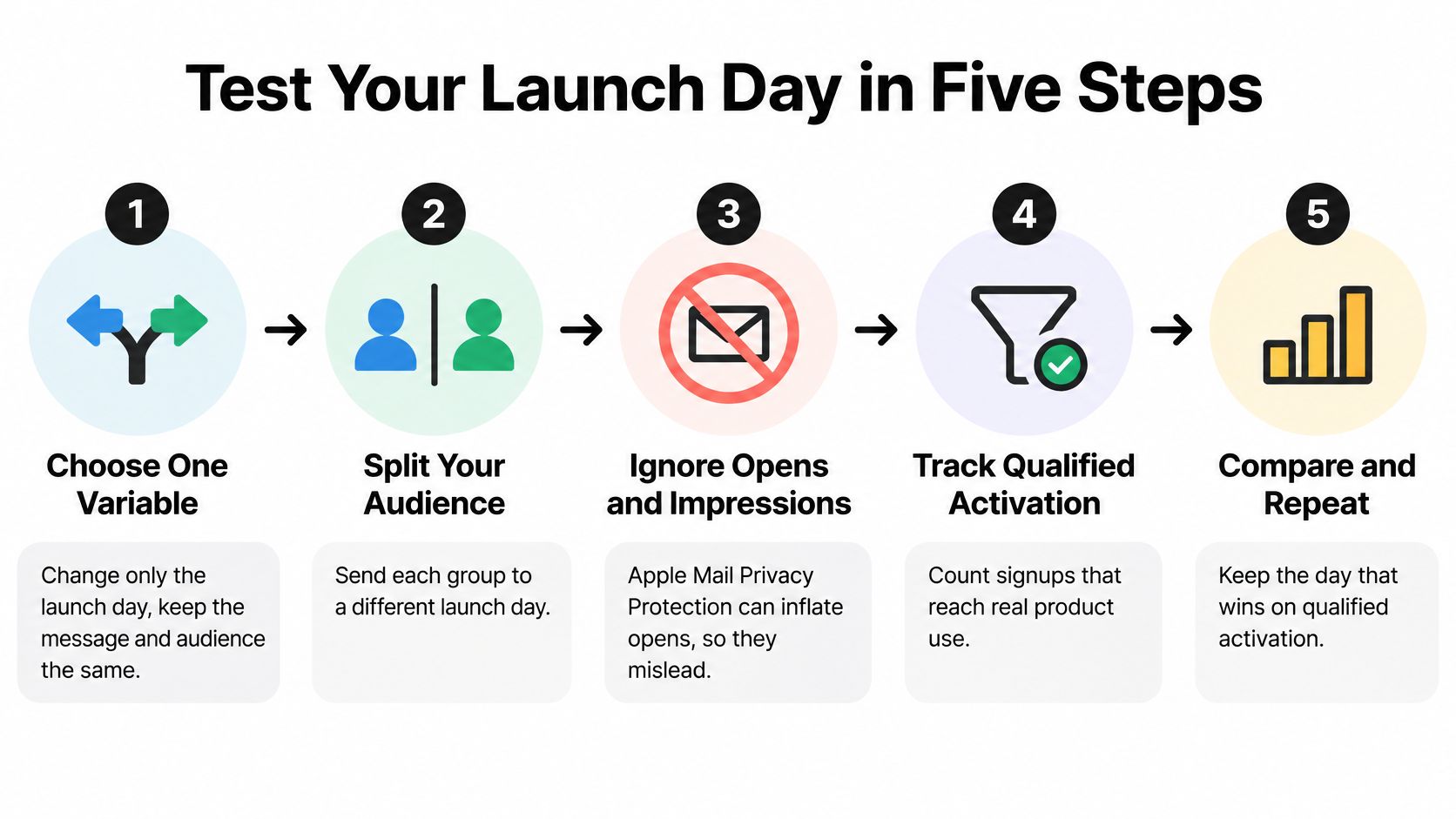
Opens are the wrong scoreboard, and they're wrong in a specific technical way. Apple Mail Privacy Protection can register an open without a human reading anything, so a day that looks strong on open rate may be strong only on prefetching. Customer.io's email scheduling guidance identifies Tuesday as a leading engagement day with Thursday near the top, while Friday can produce comparatively strong click-through and action-oriented behavior despite more moderate opens. That gap between opens and actions is exactly where a launch-day decision goes wrong.
A cohort test you can actually run
Treat each launch as a cohort experiment rather than a single event with a vibe.
- Choose one primary metric before you book. Trial starts, qualified demo requests or seven-day retention, picked in advance so you can't retroactively crown whichever number went up.
- Timestamp everything. Every exposure, landing-page visit, signup, activation event, support interaction and paid conversion gets a time and a source tag. Without timestamps you can't separate launch-day traffic from the follow-up email's traffic two days later.
- Normalize by traffic source and time zone. A Monday cohort skewed toward European visitors and a Tuesday cohort skewed toward US visitors aren't comparable until you split them, otherwise you're measuring geography and calling it timing.
- Compare seven-day retention across the days tested. Retention tells you whether the day attracted people who needed the product, which is the only version of "reach" worth paying for.
- Alternate comparable launches between Tuesday and Thursday as a holdout. Keep the message, the offer and the audience size as close to identical as you can, so the day is the only variable moving.
- Review demo completion and trial-to-paid conversion before deciding. These sit far enough down the funnel that a busy day with poor-quality traffic can't fake them.
Instrument the funnel, not just the listing
Most founders under-instrument the middle of the funnel. Define one activation event in your product analytics, something concrete like "created first project" or "connected first data source", and fire it as a server-side event so ad blockers don't erase it. Then tag every outbound link with a distinct campaign parameter per channel, and keep a single spreadsheet joining cohort day, channel, signup, activation and day-seven return.
If a large share of your discovery comes from directory and category pages, the pages themselves need to exist at scale, and these tools for scaling template pages are useful for building the kind of structured listings that keep sending visitors after launch week ends. Our product launch metrics guide covers which numbers to log, and we publish a launch checklist, launch statistics and a comparison of launch plans so you can track the same fields on our platform.
The best day maximizes qualified activation while your team can sustain fast follow-up. It is not the day with the largest first audience.
Confirm Your Launch Day and Book the Slot
Work the decision in order and it takes ten minutes.
- Name the primary goal from the lookup table, in one sentence.
- Pick the matching day. Tuesday to Thursday for reach and trials, Monday or Saturday for easier ranking.
- Confirm the hour window and time zone for your main revenue market, then schedule regional amplification around it.
- Decide placement. Free Launch costs $0 per launch and lets you choose an available Monday launch with standard placement. Premium Launch costs $19 per launch and gives priority placement in an available Monday launch. Because the Monday cohort is the less crowded one, that's where paid priority buys a real position rather than a slightly better seat in a packed room.
- Set the measurement plan before launch day, with the activation event defined and the tracking links built.
For most B2B SaaS and AI products, default to Tuesday through Thursday and move to Monday only when ranking difficulty is the constraint you most need to solve. Saturday is a benchmark, not a booking option: the bookable low-competition slot is the weekly Monday launch.
Pick your goal, pick your day, then claim the slot instead of letting the calendar pick for you. At SubmitMySaas you can publish a product page, join a Monday launch cohort at 8:00 AM UTC, and collect community votes, comments and a high-authority backlink, with a free standard placement or $19 priority placement if you want the front of a quieter week. Bring the activation metric you defined, run the cohort test on your next release, and start by browsing the plans and available launch weeks at SubmitMySaas.