Startup Marketing Guide: Channels, Metrics and Playbooks
Startup marketing made practical: choose channels by stage, track CAC and payback, and build a 90-day plan that compounds for early-stage teams.
A startup can attract attention and still struggle to grow. In 2024, 27% of startup marketers said securing marketing budget was harder than the previous year, while 57% felt confident they'd secure enough, according to Firebrand Marketing's survey of startup marketing leaders. When time and money are limited, the practical question isn't which channel is most popular. It's what evidence is strong enough to keep, change, or stop a channel.
That question is harder than it sounds. Buyers can discover a product in a community, return through search, and sign up after a recommendation, while a dashboard credits only the last visit. A useful startup marketing plan accepts that attribution is imperfect and gives the team a consistent way to make decisions anyway.
Startup Marketing Priorities by Stage
A startup isn't facing one marketing problem throughout its life. Its job changes as it moves from testing an idea to finding repeatable demand and then growing without letting acquisition costs run away.
Think about opening a restaurant. Before the doors open, the chef asks a few people to taste dishes and give honest feedback. On soft-opening nights, the team wants its first guests and learns where the service falls short. When diners start returning, the challenge becomes making the experience reliably good. At scale, the kitchen needs a system that can serve many more people without losing quality.
Four stages, four different jobs
Pre-launch is the tasting stage. The central question is whether a specific group of buyers has a painful problem that your product addresses. Talk with potential customers, test how you describe the problem, and use a simple landing page to see whether people will join a waitlist. Interviews and waitlist signups are early signals, not proof of a business, but they help you catch unclear positioning before you spend heavily on promotion.
Launch is the soft opening. Make it easy for interested people to try the product, then look beyond the signup count. Week-one signups tell you whether the announcement reached people; activation rate tells you whether those people took a meaningful first step inside the product. If signups arrive but people don't activate, the next job may be fixing onboarding rather than buying more attention.
Early traction is where you look for a channel that repeats. A launch can create a burst of interest, but a sustainable channel should bring in suitable customers again. Compare retention and channel-level acquisition cost, or CAC, rather than treating every signup as equally valuable.
Scale means expanding what works while protecting efficiency. CAC payback and LTV:CAC help you assess whether the cost of winning customers makes sense relative to the gross profit and customer value they generate.
| Stage | Main job | Primary metric | Typical channels |
|---|---|---|---|
| Pre-launch | Prove a painful problem exists | Interview count and waitlist signups | Founder outreach, communities, a simple landing page |
| Launch | Create a first burst of trial users | Week-one signups and activation rate | Product launch directories, press, email list |
| Early traction | Find one channel that repeats | Cohort retention and channel CAC | Search content, referrals, one paid test |
| Scale | Expand without losing efficiency | CAC payback and LTV:CAC | Paid search and social, partnerships, sales-assisted outreach |
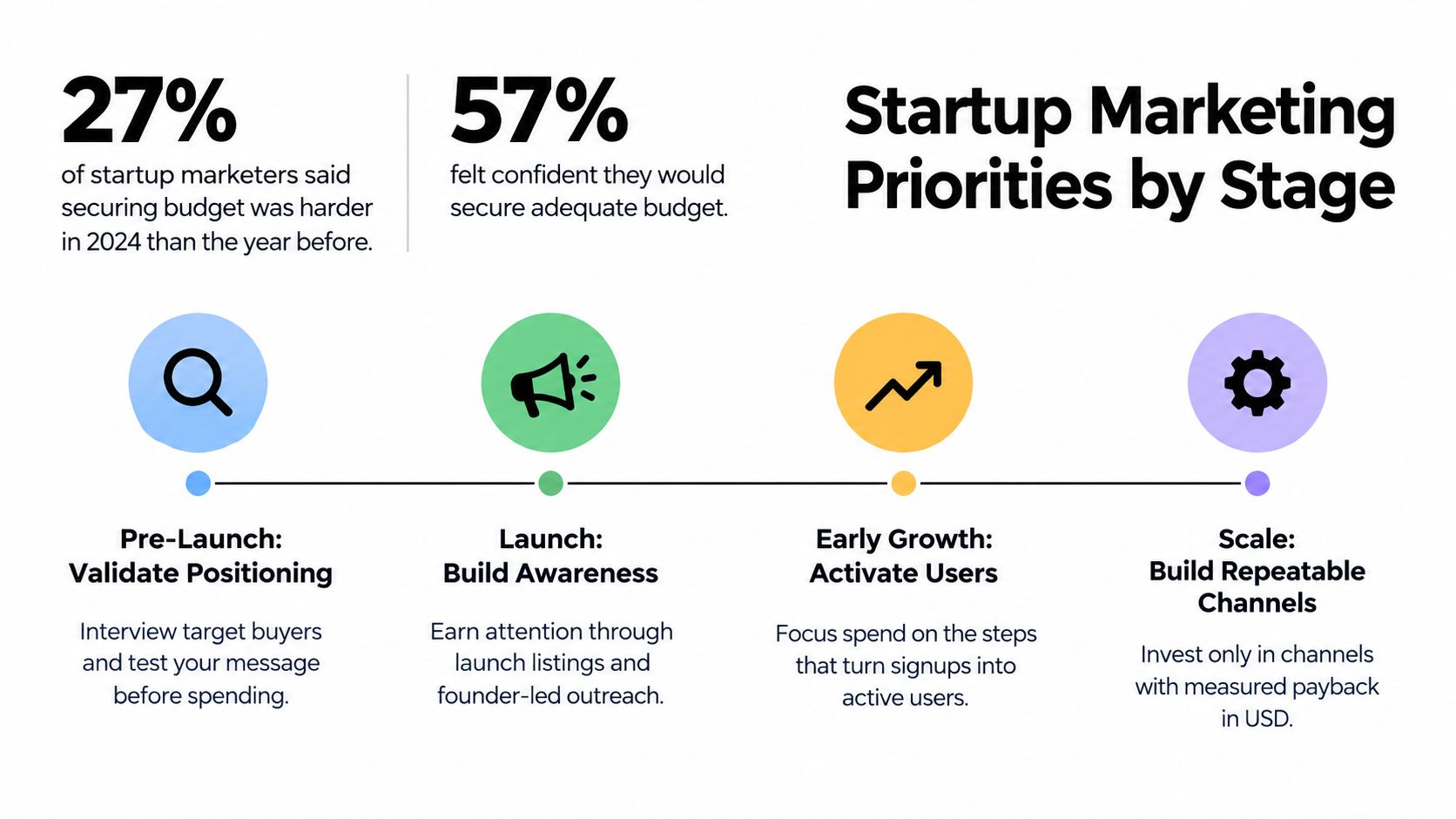
Find the row that describes your company today. Until that row is working, resist borrowing the priorities of the stage before or after it. A pre-launch founder doesn't need a scale-stage media mix, and a scaling team shouldn't judge its marketing by launch-day signups alone.
Choosing Channels for a Lean Team
A useful way to think about channels is to compare them with rent and savings. Paid search is like rent: it can put your offer in front of people quickly, but traffic generally stops when spending stops. Search content and referral loops are more like savings: they take effort to build and may not pay off immediately, but useful pages and customer recommendations can continue bringing people in.
That analogy isn't a promise that organic channels are free. They cost time, and a team can spend weeks producing content that doesn't answer a real buyer question. The point is to notice what remains after the immediate campaign ends.
| Channel | Time to first results | Cash cost | Compounds over time | Best fit |
|---|---|---|---|---|
| Search content (SEO) | 3–6 months | Low cash, high time | Yes | Products solving searchable problems |
| Product launch directories | Days | Low to moderate | Partly, through listings and backlinks | Launch week and first users |
| Communities and forums | Weeks | Low cash, high time | Partly | Niche B2B or developer audiences |
| Referral and invite loops | 1–2 months after the product works | Low, product-funded | Yes | Products with natural sharing |
| Paid search | Days | High and immediate | No, stops when spend stops | Proven high-intent keywords |
| Paid social | Days to weeks | Moderate to high | No | Visual or consumer products |
| Outbound sales | Weeks | Moderate, mostly time | No | High-contract-value B2B |
| Partnerships and integrations | 2–4 months | Low | Yes | Products that plug into tools buyers already use |
Use the table to compare trade-offs, not to predict your results precisely. Directories and communities can give a new product quick feedback, but that attention can fade if the team doesn't follow up. Search content usually takes longer to produce a signal, yet it can become a durable way to meet people already looking for a solution.
Narrow the choice before you start
For a lean team, choose one fast channel for early signal and one compounding channel for future demand. Avoid trying to manage more than two serious experiments at once. If you need help choosing where content should appear, this guide to content distribution channels can help you think about where a useful piece can reach its intended audience.
Then ask four practical questions:
- Where do buyers already spend time online? A developer tool might earn attention in technical communities; a consumer app may depend more on social discovery.
- How much is a customer worth over time? A high-value contract may support personal outreach that would be too costly for a low-priced product.
- Does using the product naturally involve sharing? Collaboration products have a built-in reason to invite others; many solo tools don't.
- Can the team sustain the work every week? A channel that requires regular publishing or thoughtful community participation won't work if nobody owns it.
A channel that suits a consumer app may be a poor match for a B2B product with a long sales cycle. For paid social, platforms can also differ in their creative and campaign workflows. If you're comparing ways to manage campaigns, this overview of Meta and TikTok ad automation options offers a useful look at the kinds of tools available.
Growth Loops Versus Funnels
Most founders can draw a funnel on a whiteboard: awareness, signup, activation, payment. The funnel is useful for finding where people drop off, but it's also a bucket. If customers leave and nothing they did brings in the next customer, the team must keep adding new traffic.
A growth loop works differently. Think of a sourdough starter: you save some from one batch so it can help make the next loaf. In a product, a user's action creates something that helps another person discover or try the product. The team still needs to seed the process, and the loop only continues if the product gives users a reason to take that action.
Four loop patterns to look for
A content loop turns product use into public material. For example, a website builder might let a customer publish a public page that can appear in search results and introduce new readers to the tool.
A referral loop makes an invitation part of getting work done. A project-management product could let a user invite a collaborator to view a shared project. The invitation has a clear purpose, rather than asking someone to share an advertisement.
A user-generated loop turns customer-created material into discovery. A scheduling product might publish public templates or reports that other people can browse and adapt. Those materials help the next visitor understand what the product can do.
An integration loop connects discovery to another product's ecosystem. A tool listed in a marketplace can reach people who already use the connected software and are looking for an add-on.

Loops matter partly because buying attention can get more demanding as a SaaS company grows. Benchmarkit's 2025 SaaS Performance Metrics data, as summarized in coverage of SaaS marketing benchmarks, reports that the median company spent $2.00 in sales and marketing to acquire $1.00 of new-customer ARR in 2024, a 14% increase from the previous year. The same benchmark reports that median CAC payback periods rose 12.5% since 2022.
Those figures describe benchmark medians, not a forecast for your company. They do underline why it's risky to judge growth by launch attention or visitor volume alone. Customers who don't activate or stay may make a busy funnel look better than the underlying business.
A loop also isn't a shortcut around product quality. If users don't want to share, invite collaborators, publish material, or connect the product with another tool, the loop has no fuel. Most loops start slowly, so a separate channel may be needed to bring in the first users.
Draw the loop on one page: user action → output → new user → product-quality step. Name the action, show what it creates, and identify how another person encounters it. Then mark the step that depends most on product quality. If users won't complete that step, improve the product experience before investing in promotion.
Metrics That Decide Whether a Channel Stays
Customer acquisition cost, or CAC, turns sales and marketing activity into an economic measure: total sales and marketing expenditure divided by new paying customers. Startup benchmarks show why there isn't one universal CAC target. First Page Sage's startup CAC benchmarks report average B2B CAC of $429 in cybersecurity and $923 in financial services. Consumer CAC in the listed categories ranged from $73 in cybersecurity to $247 in industrial IoT.
These category averages aren't targets for an individual company. Contract size, sales complexity, trust requirements, and purchase frequency all affect the cost of winning a customer. Compare your own channel and customer segments, then use CAC alongside retention and customer value.
| Metric | Formula | What it tells you | Watch out for |
|---|---|---|---|
| Blended CAC | Total sales and marketing spend ÷ new paying customers | Overall cost to acquire one customer | Hides which channel is failing |
| Channel CAC | Channel spend plus founder hours ÷ customers from that channel | Whether one channel earns its cost | Needs consistent tagging to be accurate |
| CAC payback | CAC ÷ monthly gross profit per customer | Months needed to recover acquisition cost | Lengthens as CAC rises |
| LTV:CAC ratio | Customer lifetime value ÷ CAC | Long-run return per acquisition dollar | LTV estimates are often optimistic |
| Activation rate | Users reaching the first key action ÷ signups | Whether traffic is qualified | Signup growth with flat activation signals the wrong audience |
| Week-four retention | Users active in week four ÷ users in the week-one cohort | Whether acquired users stay | Averages can hide weak cohorts |
Connect acquisition cost to customer quality
CAC payback estimates how long it takes to recover the acquisition investment from a customer's gross profit, not just their revenue. If it takes longer to recover the cost, the company needs more time and cash to earn back its marketing investment. Retention affects that calculation: a customer who leaves quickly may not generate enough gross profit to repay the cost of acquiring them.
LTV:CAC compares estimated lifetime customer value with the cost of acquisition. Founders often use a 3:1 ratio as a rule of thumb, but it isn't a law or a substitute for checking assumptions. If your lifetime-value estimate assumes that customers will stay longer than they do, the ratio will look healthier than the business really is.
Activation and retention help explain what CAC alone can't. A channel might bring plenty of signups, but if few users reach the first meaningful product action, its audience or message may be wrong. For help thinking through how different touchpoints receive credit, see this guide to attribution modeling.
Two habits make these metrics more useful. Compare cohorts, not just overall averages: users acquired through one campaign may behave differently from those acquired earlier. And count founder hours in channel CAC: unpaid outreach still uses time that could have gone to product work, customer conversations, or another channel.
Deciding to Keep, Change or Stop a Channel
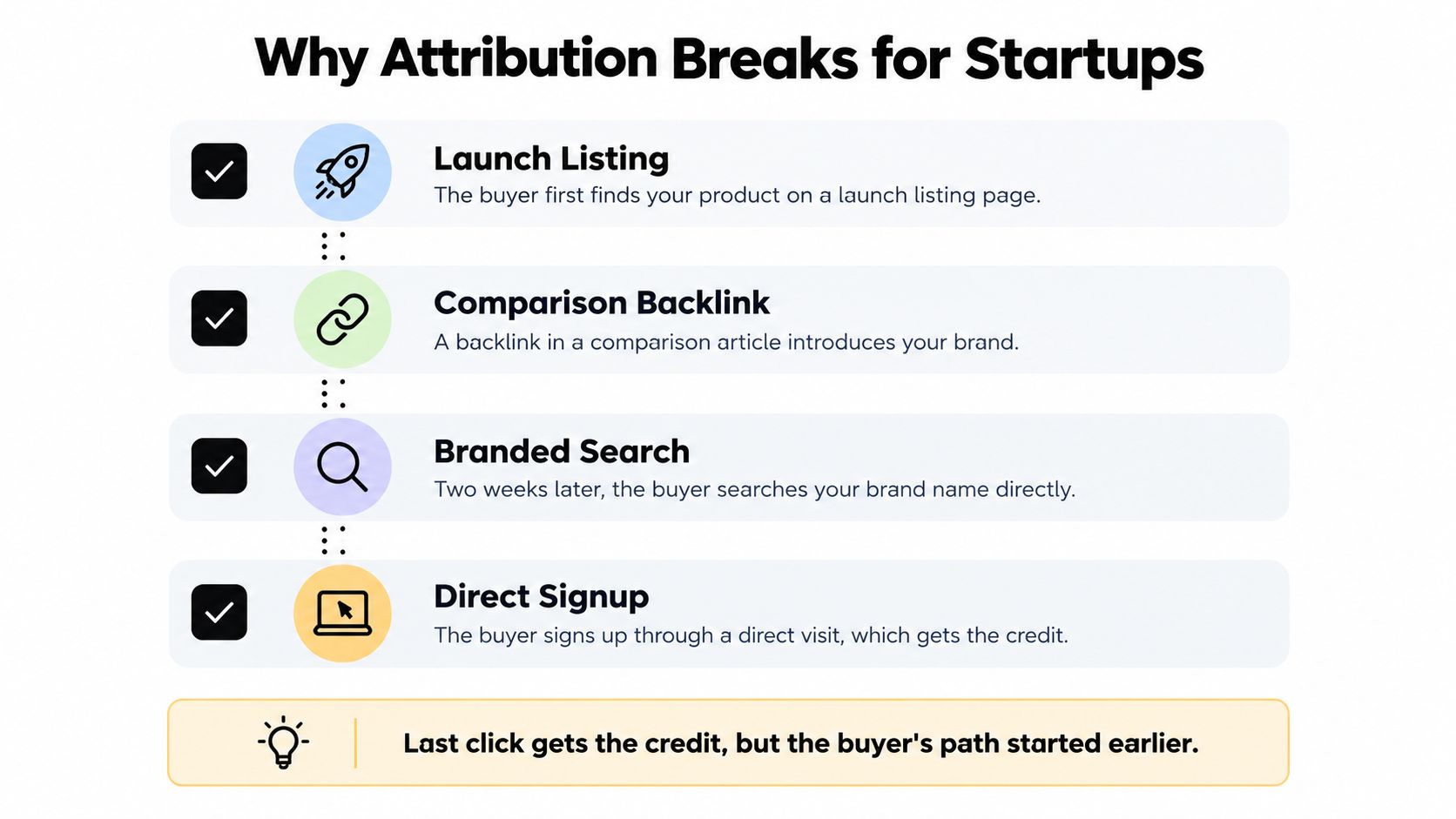
Attribution breaks easily in a startup. A buyer might first see a launch listing, later encounter a backlink in a comparison article, search the brand directly, and then sign up. A last-click dashboard may credit the direct visit, even though the journey began somewhere else.
That isn't a reason to wait for perfect tracking. In a 2025 survey of 1,645 businesses operating for eight years or less, 28% identified measuring what was working as a first-year marketing challenge, while 32% cited insufficient time, budget, or skills. A small team can spend more energy building a complex attribution system than using the evidence it already has.
Build a lightweight decision system
Start with a simple routine:
- Choose one primary outcome. For example, track paid activations rather than treating every visit or signup as a business result.
- Tag campaign links consistently. Use a naming convention the team can maintain, and keep it consistent across channels.
- Ask one source question at signup. A short “Where did you hear about us?” field captures a customer's own account of how they found you.
- Compare monthly cohorts. Look at groups acquired in the same period instead of drawing conclusions from a few isolated clicks.
- Review channels on a fixed monthly cadence. A regular review makes it harder to keep funding a weak channel just because its report looks busy.
Then make a decision for each channel:
- Keep it when it brings qualified signups at or below your target CAC.
- Change it when signups arrive but activation is weak. That often points to a mismatch in audience, message, or landing-page promise.
- Stop it when it produces no qualified signups after the time it reasonably needs to show results.
There's an edge case: a channel may have weak direct revenue while branded searches rise. If other evidence suggests that people are encountering and remembering the brand, keep watching it for two more quarters before treating the lack of last-click sales as a final verdict.
Numbers don't explain every journey, so compare signup answers with what customers actually say. Speak with five customers in short interviews, ask what they remember and what prompted them to try the product, and look for patterns rather than trying to make one person's story explain every conversion.
Where AI Search Fits in a Lean Plan
AI discovery is worth watching, but it shouldn't displace the work that already helps buyers find and assess a product. In 2025, Ahrefs reported that AI generated about 0.1% of total referral traffic, even as AI traffic had grown approximately 9.7 times since 2024. Smaller sites receiving fewer than 10,000 visits a month saw around 0.3% of traffic from LLMs, compared with 0.1% for sites receiving more than one million visits, according to Ahrefs' AI marketing statistics.
The same source summarizes BrightEdge's January–August 2025 analysis, which found AI referrals were less than 1% of referral traffic, while conventional organic search remained the larger driver and converted more strongly. Those findings describe the sources and periods analyzed. They don't tell an individual startup exactly how much traffic it will get, but they do argue against treating AI search as a proven replacement for conventional search.
Build in priority order
First, strengthen the base. Make the site technically accessible to search engines and publish useful content that answers real buyer questions. A clear page about the problem your product solves is more valuable than a hurried attempt to publish generic content for AI systems.
Next, make product information easy to interpret. Write clear product pages, comparisons, and documentation. Include first-party evidence that accurately shows how the product works, so both people and search tools can understand the offer.
Then, measure discovery. Watch branded search trends, the quality of referral traffic, assisted conversions, and whether your product appears in AI answers to questions buyers ask. Treat those measures as clues, not proof that one page or tactic caused a sale.
For teams working on authority and discovery, this guide to SaaS link building can help connect useful product information with relevant sites and audiences.
An early-stage team can reserve a modest, fixed share of content time for clear product and comparison pages. Treat AI visibility as a possible result of solid search work, not as a separate campaign that consumes the whole content budget. A crowded category with established review sites may need more effort on third-party coverage; a niche product with little search demand may find AI answers a useful early place to test whether its product information is understandable.
Review three signals quarterly: branded search trend, referral source quality, and whether the product appears in answers to the five questions buyers ask. If those signals are weak, improve the underlying content and product explanation before adding more tactics.
How to Run a 90-Day Launch Plan
A three-person team is preparing to launch invoice software for freelancers. The launch is twelve weeks away. The founders don't need a complicated marketing department; they need a clear outcome, a small number of channels, and a routine for learning from the people who try the product.
Set the outcome and learn the buyer's language
First, choose one primary outcome. For this team, it's paid activations within 90 days. A signup alone doesn't count as success if the freelancer never sends an invoice or pays for the product. Set a target channel CAC before spending, so the team has a standard for comparing what each channel costs with the customers it brings.
Next, interview potential buyers. Talk to freelancers who handle invoicing themselves, and write down the exact language they use about the problem. Don't lead them toward the product's planned features. Ask how they currently create, send, and track invoices, what frustrates them, and what they do when something goes wrong. Those conversations can shape the landing-page headline, the product's first-run experience, and the examples used in outreach.
Then, build one landing page. Keep the page focused on the buyer's problem, the product's value, and one next step. Use tagged links for each campaign and add a short signup question asking where the person heard about the product. A waitlist helps the team collect interest before launch, but it shouldn't be mistaken for a group of activated customers.
Coordinate the launch and inspect onboarding
Plan the launch week as a focused test. The team can prepare a directory listing, two relevant community posts, and an email to its waitlist. Each activity needs an owner, a tagged link, and a clear purpose. A listing may bring signups and feedback quickly, but the team should treat it as an early signal and follow up with the people who show interest.
SubmitMySaas offers a Free Launch for $0, with standard placement in an available Monday launch. Weekly launches go live together every Monday at 8:00 AM UTC. A Free Launch earns a dofollow backlink only if the product ranks in the top three weekly and displays the SubmitMySaas badge on its site, so don't build the plan around an assumed backlink.
Launch on a fixed day and log sources promptly. The team should record each signup's source within a day, while the visit and campaign details are still fresh. If the source is unclear, preserve that uncertainty rather than assigning a guess. Consistent, imperfect information is more useful than precise-looking data based on assumptions.
A short product walkthrough can also help the team check whether the message matches the product experience:
Watch new users attempt the first task and fix the friction. In weeks seven to nine, observe five new users trying to send their first invoice. Notice where they hesitate, what they misunderstand, and whether the product asks them to do something they don't expect. Then improve onboarding before concluding that the acquisition channel brought poor-fit customers.
Make a decision with the evidence you have
Shift resources only after comparing activation and cost. In weeks ten to twelve, add budget to the channel with the lowest CAC among those meeting the team's activation target. Pause the weakest channel rather than spreading a small budget thinly across every place the founders could advertise.
Three common mistakes can blur the results:
- Launching without tracking: the team can't tell which activity brought a signup.
- Counting signups instead of activations: a busy signup page can hide an onboarding problem.
- Splitting effort across too many channels: each test gets too little attention to produce a useful signal.
At day 90, the founders should have a one-page channel scorecard, a keep/change/stop decision for each channel, a date for the next 30-day review, and one named channel to test next. That record matters more than a polished launch report: it shows what the team observed, what it changed, and what it will do with the next round of evidence.
If you're preparing a product launch, SubmitMySaas lets makers submit their products for visibility, feedback, and a backlink. Use SubmitMySaas to explore a launch listing as one measured part of your acquisition plan, then track whether the exposure brings qualified users.