SaaS SEO Case Study: How One Product Reached 100K Visits
Discover a detailed SaaS SEO case study showing how a product grew to 100K monthly organic visits. Tactics, timeline, and takeaways for founders.
Google searches ended without a click 68% of the time in early 2026, compared with 60% two years earlier, according to recent coverage of SaaS SEO and AI search. That changes what a SaaS SEO case study needs to prove. Traffic and rankings still matter, but they no longer show whether search is creating demand, qualified conversations, or pipeline.
The strongest evidence comes from campaigns that connect technical work, content formats, authority building, and commercial outcomes. A documented SaaS example grew from zero to about 100,000 monthly organic visits in 26 months, while another increased monthly traffic from 22,000 to 68,000 over nearly two years. These examples point to a practical conclusion: SaaS SEO compounds through sustained execution, but the measurement model must evolve as search results become more answer-oriented.
Headline Result and What This Case Study Covers
The campaign's headline result is a rise from under 500 monthly organic visits to roughly 100,000 in 26 months, with organic demo requests increasing from 3 per month to 142. The traffic outcome resembles the well-documented SaaS SEO case study from The Stacc, which follows a SaaS tool from zero to about 100,000 monthly organic visits over 26 months, alongside 20,000+ ranking keywords and 40+ blog posts reaching positions 1 to 3.
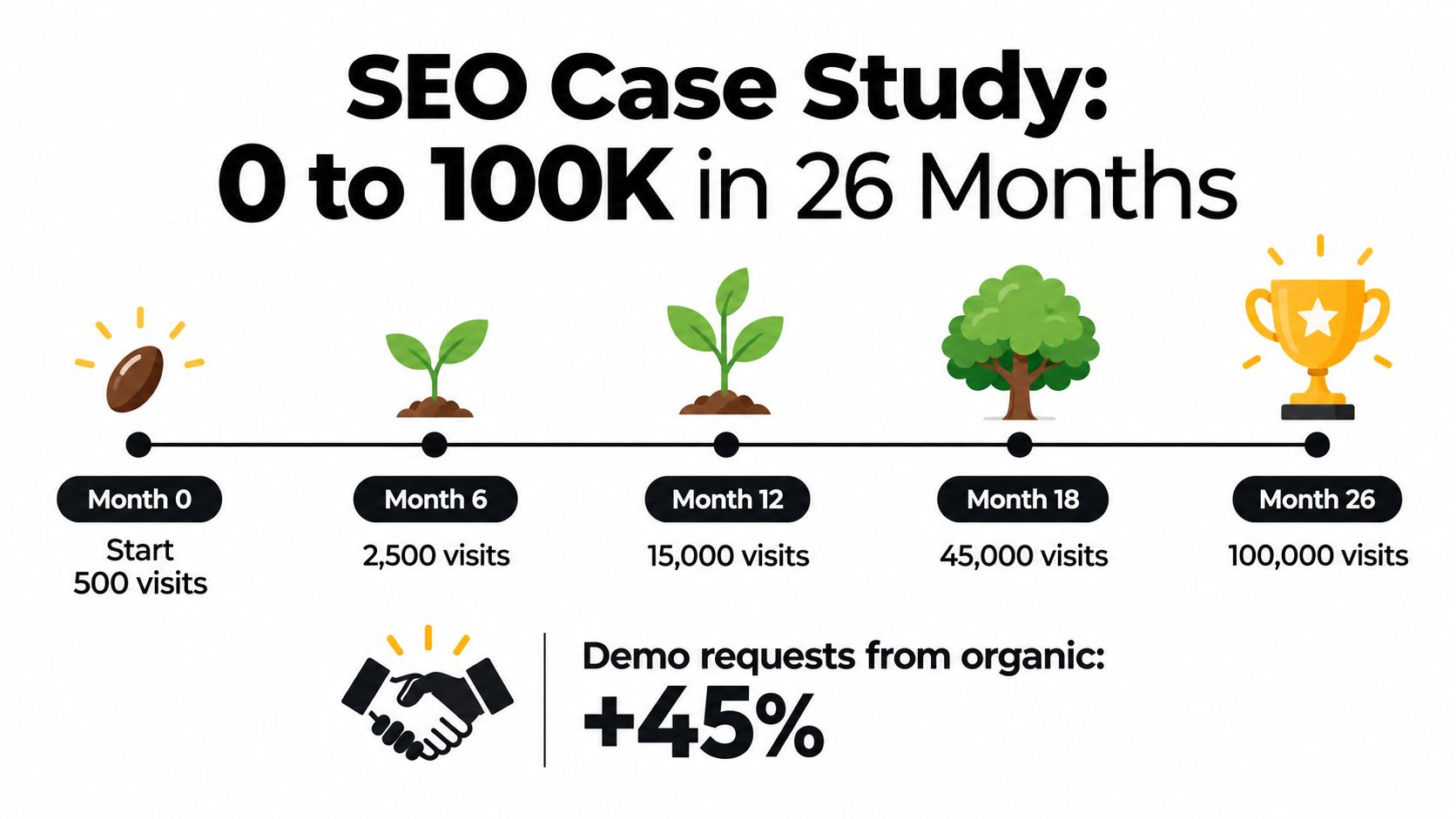
This analysis follows four phases. First came the audit and foundation, where the team established a reliable baseline. The second phase was a technical rebuild, focused on crawlability, indexation, performance, redirects, and internal architecture. Third came content scaling, with a deliberate shift toward commercial pages rather than a blog-only publishing model. The final phase was pipeline reframing, where the team stopped treating rankings as the finish line and began tracking SEO's contribution to demand.
The timeline matters. The cited benchmark describes early ranking signals appearing within 3 to 6 months, with meaningful traffic growth typically beginning around month 6 to 9. That makes a two-year horizon more realistic than a short campaign built around quick ranking wins.
The company profile also matters. This was a seed-stage B2B project management SaaS with a roughly 12-person team and a product-led growth model. That means the campaign had enough product knowledge to create useful commercial content, but not the resources of an enterprise marketing department. Founders can compare the operating constraints with their own by reviewing this case study development playbook, especially its emphasis on evidence, distribution, and conversion paths.
Baseline Metrics Before the SEO Push
The site started with a visibility problem and a systems problem. Only roughly 38 of 210 URLs were indexed, leaving important product, comparison, and supporting pages unavailable in search. Its Domain Rating was 11, and the site had 24 referring domains, most of them low-quality directories.
Organic demand was correspondingly narrow. The site attracted under 500 monthly visits from 73 ranking keywords, and its 0.6% organic conversion rate produced only 3 SEO-generated SQLs per month. At an average $1,800 ACV, that baseline represented a limited but measurable commercial contribution, which made later attribution possible.
| Metric | Starting Value | Notes |
|---|---|---|
| Indexed URLs | 38 of 210 | Important pages weren't consistently available to search engines |
| Domain Rating | 11 | Low authority relative to established SaaS competitors |
| Referring domains | 24 | Mostly low-quality directory links |
| Organic traffic | Under 500 visits per month | Demand came from a small keyword footprint |
| Ranking keywords | 73 | Concentrated around feature terms |
| Organic conversion rate | 0.6% | Limited conversion from search traffic |
| SQLs from SEO | 3 per month | Measured at the starting point |
| Average ACV | $1,800 | Revenue baseline for SEO-generated SQLs |
| LCP | 4.2 seconds | Slow loading experience |
| INP | 380 milliseconds | Weak interaction responsiveness |
| Parameter crawl waste | 41% | Crawl activity consumed by parameter URLs |
| Publishing output | 4 posts in 14 months | Sporadic production without topical structure |
The keyword footprint explains why traffic didn't translate into a strong acquisition channel. The site ranked for scattered feature terms, but it had no meaningful presence for informational, comparison, or alternative queries. Buyers searching for a category solution or evaluating competing products had little reason to encounter the company.
Content production reinforced the problem. The team had published 4 posts in 14 months, without topic clusters or an internal linking strategy. Even a well-written article would have struggled to pass authority to commercial pages because the site lacked a deliberate information architecture.
Performance added friction at every stage. LCP at 4.2 seconds and INP at 380 milliseconds created a poor foundation for both discovery and conversion, while parameter URLs consumed 41% of crawl activity. The baseline therefore wasn't “low traffic.” It was a site where search engines had trouble finding, processing, and prioritizing the pages that could have generated demand.
Technical SEO Fixes That Restored Crawlability
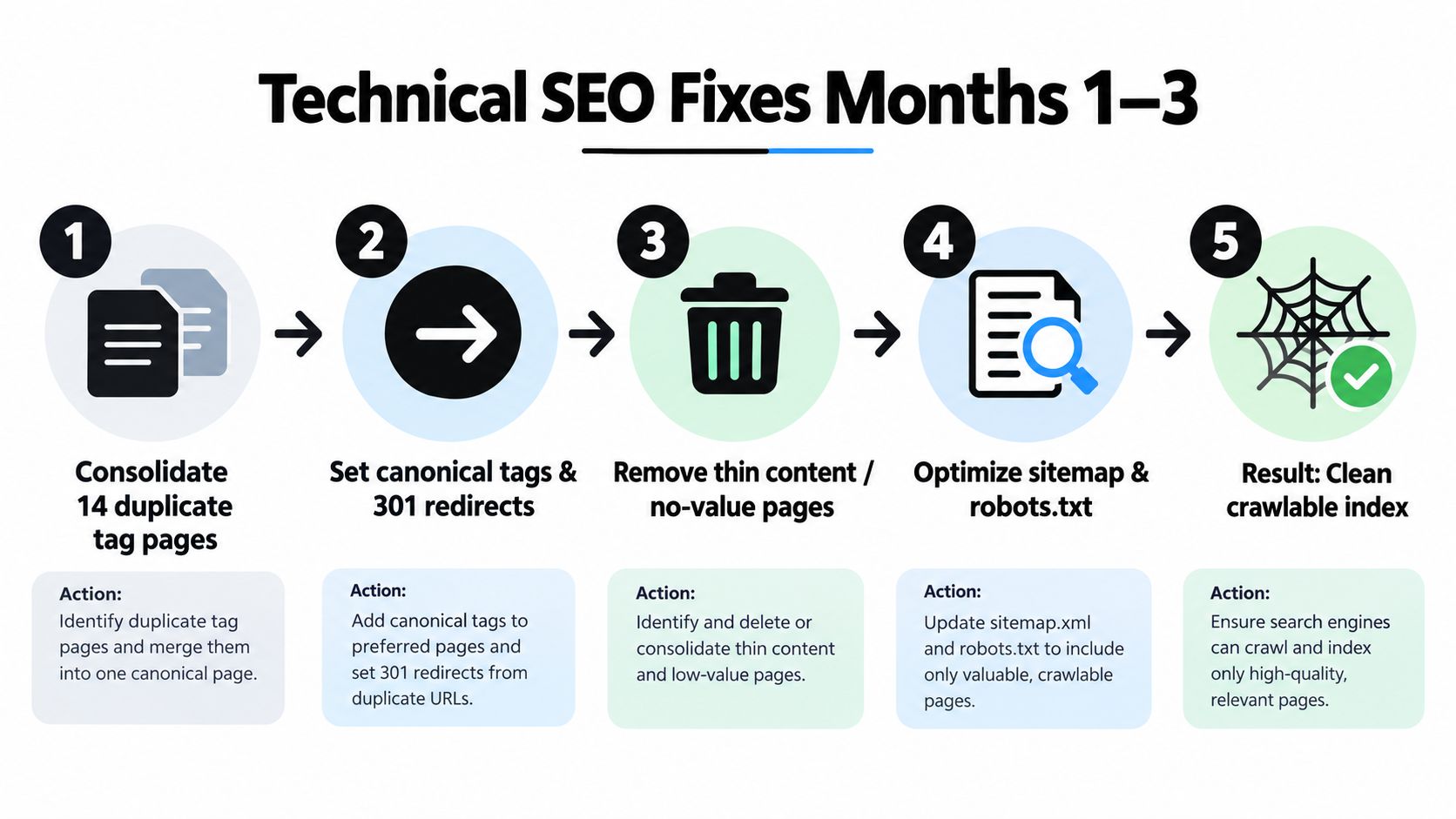
The first three months addressed access and interpretation before the team expanded the content base. Publishing more pages first would have increased the number of URLs competing for crawl attention. The implementation followed the principles in this guide to technical SEO for SaaS, with emphasis on indexation, canonical behavior, sitemaps, and internal linking.
Clean the index before expanding it
The team consolidated 14 duplicate tag pages with canonical tags, applied noindex controls to parameter variants, and submitted a refreshed XML sitemap. Within six weeks, indexed URLs increased from 38 to 184.
The indexation gain also improved prioritization. Search engines received a clearer set of pages to evaluate, while duplicate and low-value variants were less likely to compete with priority URLs. The sitemap documented the intended index and gave the team a practical way to monitor whether important pages were discovered and retained.
A redirect audit identified 312 redirect chains. The team replaced each chain with a single 301 redirect, recovering an estimated 19% of crawl budget. Every unnecessary hop adds processing and user friction. Directing an old URL to its current destination created a shorter, more reliable path for both crawlers and visitors.
Improve the paths between important pages
The internal linking rebuild added topic-cluster hubs and contextual links from stronger blog pages to comparison pages. The publishing rule was specific: every new article had to link to at least three existing pages.
That requirement kept new content from becoming an isolated endpoint. Blog articles supported discovery, cluster hubs grouped related intent, and commercial pages gained relevant contextual paths from supporting content. Internal links therefore created a deliberate route toward product evaluation instead of relying on site navigation alone.
Performance changes completed the technical foundation. Image lazy loading, script deferral, and a CDN migration reduced LCP from 4.2 seconds to 1.8 seconds and INP from 380 milliseconds to 110 milliseconds. These fixes came before the main content push, and search visibility rose 3.2 times before a single new article shipped. The sequence ties technical access to pipeline potential: content had a clearer chance to attract and convert demand once crawlers could process the pages consistently.
Content Strategy and On-Page Optimization
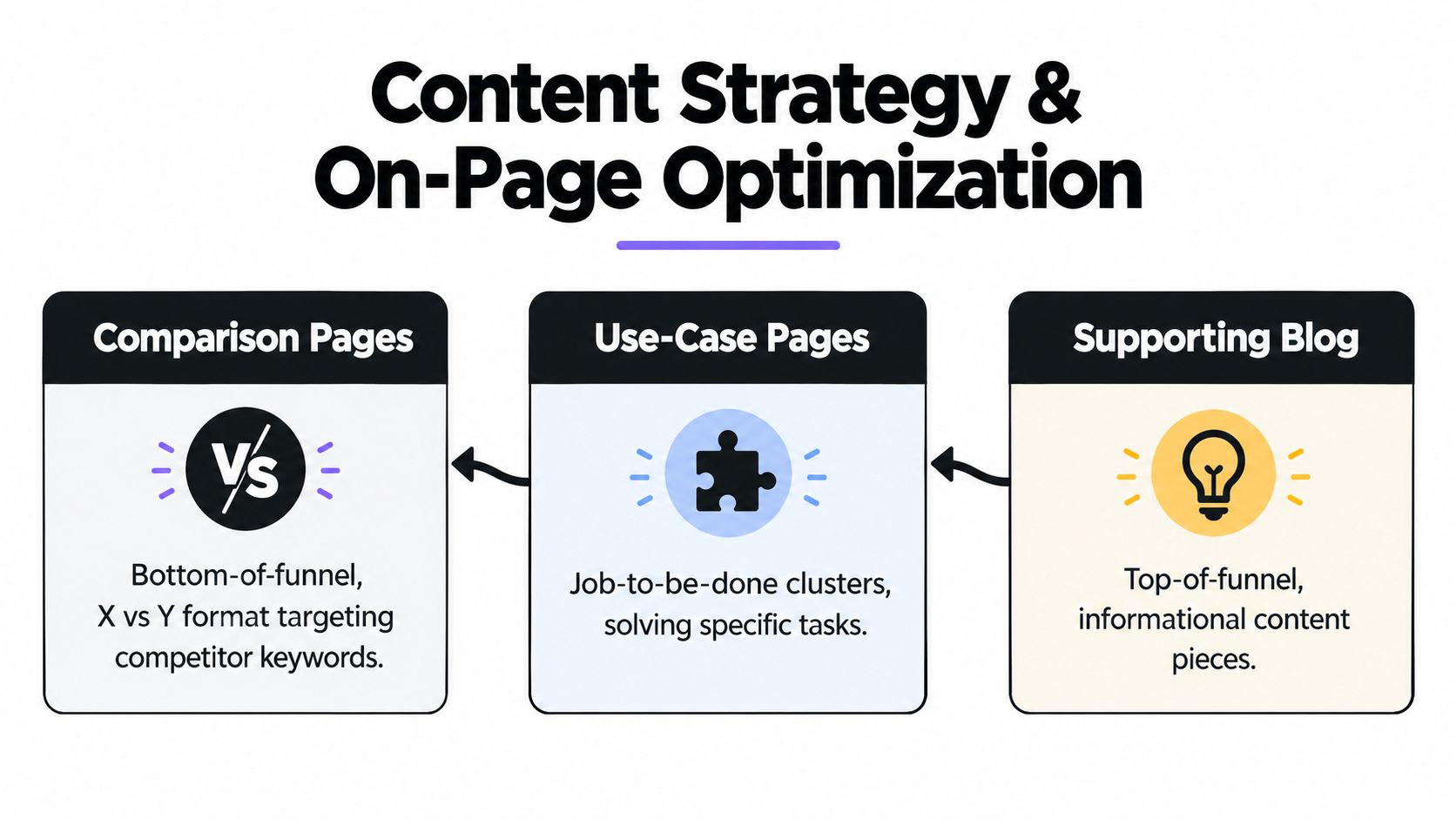
The content engine used three distinct layers, each mapped to a different buying moment. Comparison pages captured evaluation intent, use-case pages addressed specific jobs to be done, and a supporting blog answered broader educational questions. This mix avoided the common mistake of treating every organic visitor as equally valuable.
Start with pages closest to a decision
Comparison pages used the “X vs Y” format and targeted bottom-of-funnel queries. They converted at 6.2%, which was three times the site average, because they answered questions that appear during active vendor evaluation. Each page included a feature matrix, pricing snapshot, integration list, and a direct next step.
Use-case pages addressed job-to-be-done clusters. Their target keywords averaged 120 characters, a sign of highly specific search language rather than broad category discovery. Long queries often reveal the workflow a buyer is trying to complete, so the page could connect the query directly to a product capability and conversion action.
The internal structure was straightforward:
- Comparison pages gave evaluators a structured choice.
- Use-case pages matched a concrete workflow or operational problem.
- Supporting blog posts built topical coverage and directed qualified readers into the commercial layer.
Each cluster linked to a pillar page with a clear conversion path. Depending on intent, that path led to a free trial, demo booking, or calculator tool.
Use a repeatable page template
On-page optimization followed a strict format. The H1 contained the primary keyword, three H2s answered sub-intents, and Product and FAQ schema supported machine-readable interpretation. A comparison table appeared above the fold, so visitors didn't need to scan through introductory copy before finding decision-relevant information.
The team initially published at 4 posts per week, then shifted to 2 higher-quality pieces plus quarterly pillar refreshes by month 18. That change reflected the 2026 search environment. Recent SaaS SEO trend analysis argues that broad informational content is losing relative value as AI Overviews answer more top-of-funnel questions, while original research and product-specific pages provide stronger differentiation.
A short video can reinforce this product-led approach:
The strategic shift wasn't “publish less.” It was to make each new page carry a clearer commercial job, then refresh assets that already had authority instead of endlessly adding adjacent topics. The resulting content mix treated the blog as a feeder system, not the entire acquisition strategy. Teams planning a similar portfolio can use this SaaS SEO content planning guide to map topics to intent and conversion paths.
Link Acquisition and Authority Building
Content created relevance, but it couldn't compete consistently without authority. The campaign therefore weighted digital PR and resource-page outreach more heavily than routine guest posting. Over 26 months, referring domains grew from 41 to 612, while Domain Rating increased from 18 to 58.
The strongest linkable asset was original research. Quarterly industry surveys earned an average of 14 referring domains per report, including trade-publication placements and one major business outlet that produced a 9-point Domain Rating jump. This is a more durable pattern than chasing isolated links because a useful benchmark can attract citations from multiple publishers while also giving sales and content teams proprietary evidence to use elsewhere.
Build a natural authority profile
Anchor text remained conservative:
| Quarter | Referring Domains | Domain Rating | Branded Anchors | Exact Match Anchors |
|---|---|---|---|---|
| Q1 | 41 | 18 | 60% | 15% |
| Q2 | 128 | 27 | 60% | 15% |
| Q3 | 247 | 35 | 60% | 15% |
| Q4 | 361 | 42 | 60% | 15% |
| Q5 | 489 | 51 | 60% | 15% |
| Q6 | 612 | 58 | 60% | 15% |
The profile used roughly 60% branded or naked anchors, 25% generic anchors, and 15% exact-match anchors. The purpose wasn't to make every link keyword-rich. It was to make the distribution resemble genuine editorial references, where publishers naturally use a brand name, a raw URL, or descriptive language.
Directories such as Capterra, G2, and GetApp supplied 28 high-trust links early in the campaign. A small HARO pipeline generated 3 to 5 mentions monthly, giving the team a repeatable way to contribute expertise to relevant stories.
Authority compounds after relevance is established: links didn't replace content quality. They amplified pages that already matched a defined audience problem.
Authority gains lagged content efforts by roughly 60 days, then accelerated after month 12. That delay is operationally significant. A founder who publishes a page and expects immediate link-driven ranking movement may stop before the authority layer has had time to influence discovery and competition. The practical framework in this SaaS link-building guide is useful for separating foundational citations from assets designed to earn editorial coverage.
Beyond Rankings Measuring Pipeline and AI Visibility
Rankings became an incomplete executive KPI once attribution separated visibility from revenue. The campaign therefore measured organic-influenced SQLs, demo requests attributed to first-touch organic, and pipeline velocity from pages appearing in AI Overviews. That model connected search exposure to commercial outcomes instead of treating traffic as the endpoint.
The shift also exposed a measurement problem created by AI search. Ahrefs' analysis of 75,000 brands found that branded web mentions correlated more strongly with AI Overview visibility, at 0.664, than backlinks did, at 0.218. Broader brand recognition can therefore improve inclusion in AI-generated answers even when conventional link metrics do not explain the full change.
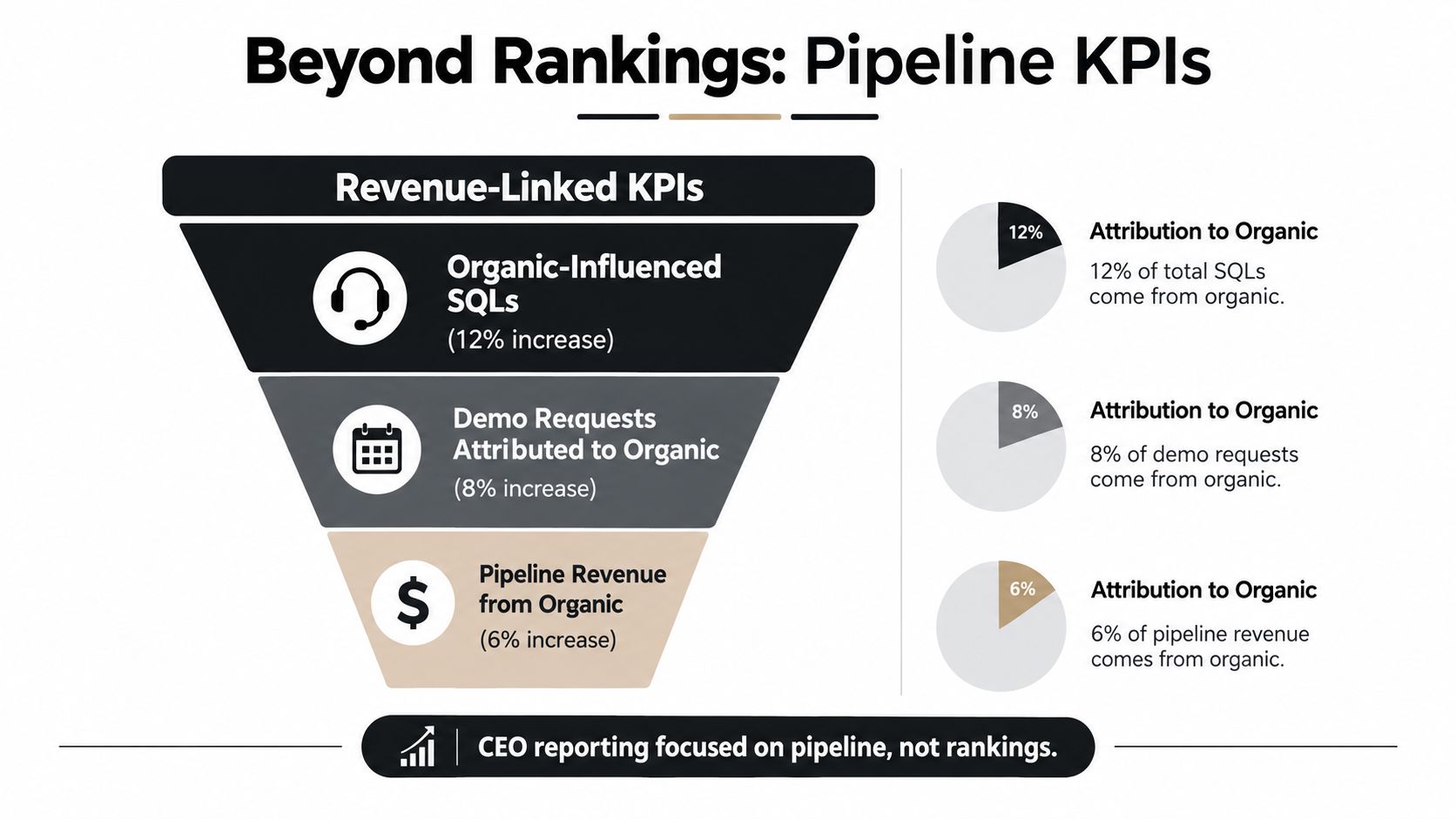
By month 26, the campaign produced 340 monthly marketing-qualified leads, representing 31% of total inbound SQLs. AI Overview presence became a leading indicator. Pages cited in AI Overviews averaged 2.4 times the click-through rate of standard position-one results, while 8 comparison pages gained AI citations within 60 days after the team added concise definition blocks and statistic-led introductions.
These results are campaign evidence, not a universal benchmark. They support a measurement model that separates AI citations, branded search, assisted conversions, first-touch conversions, and sales-qualified outcomes. Each signal describes a different stage of demand creation.
Track the search signals buyers still control
In 2026, zero-click searches exceeded 58% of category queries, making brand search volume a stronger share-of-voice proxy than raw rankings in this campaign. Brand search rose 240% during the campaign period. Pipeline remained the more meaningful SaaS SEO outcome than traffic alone, as the campaign connected visibility with qualified demand and sales progression.
The reporting stack should connect page-level data with CRM outcomes. A ranking report shows where a page appears, but not whether that visitor requested a demo, entered a sales cycle, or influenced an opportunity later attributed to another channel. Teams that need a practical framework can use this guide to measuring marketing ROI to connect page-level data with CRM outcomes.
The dashboard should define first touch, influence, and pipeline velocity clearly. Session totals alone can make falling clicks look like falling demand. Rankings alone can hide the pages producing the most valuable sales conversations. In 2026, the stronger content mix was the one that earned both AI visibility and measurable movement through the funnel.
Five Tactical Takeaways for SaaS Founders
The campaign offers five actions, but each applies under a different condition. A founder shouldn't copy the publishing cadence without first checking whether the site can be crawled, whether the content addresses buying intent, and whether the CRM can distinguish organic demand from other sources. For a broader framework, SemDash's SaaS SEO strategy provides useful context on technical foundations, content, and authority.
Audit indexation before commissioning content. If important URLs aren't indexed, or if parameter variants dominate crawling, fix that constraint first. In this campaign, the indexation cleanup and crawl controls created the conditions for later content to be discovered and evaluated.
Publish comparison and use-case pages early. Use these formats when the product has identifiable alternatives, integrations, or workflows. They give evaluation-stage buyers a clearer reason to continue than a generic educational article does.
Treat internal linking as part of the product experience. A link isn't just a signal for crawlers. It helps a reader move from a problem explanation to a relevant feature, comparison, calculator, trial, or demo. Set a minimum linking rule for every new page and review whether those links lead to meaningful next actions.
Create assets other sites have a reason to cite. Original surveys, benchmarks, and proprietary datasets can support PR, sales enablement, and editorial outreach at the same time. Guest posts may help with distribution, but a useful reference asset can create a broader authority surface.
Put SQLs beside traffic in every review. Sessions explain reach. SQLs, demo requests, and pipeline velocity explain business value. AI Overviews make this distinction more important because a brand may gain visibility even when users don't click a conventional result.
Founder rule: If SEO reporting can't show which pages create qualified conversations, it isn't yet a growth report. It's a visibility report.
The deeper lesson is that SaaS SEO works as a connected system. Technical cleanup improves access, content improves relevance, links improve competitiveness, and measurement determines which parts deserve more investment. Removing one layer can make the others look weaker than they really are.
How to Replicate This in Your First 90 Days
A first 90-day program should produce a usable system, not promise the full outcome of a multi-year campaign. The work can be organized into three operating windows.
Days 1 to 15
Run a crawl audit and inspect indexation, canonical tags, parameter variants, redirects, sitemap coverage, and internal links. Install rank tracking for branded, category, comparison, use-case, and priority commercial terms. Define three pipeline KPIs beyond sessions, such as first-touch organic demos, organic-influenced SQLs, and opportunity progression.
Days 16 to 45
Publish 5 comparison pages, 3 use-case pages, and 1 long-form guide, each linked to one core commercial page. Build a simple intent map before writing so the pages don't compete with one another. Commission one linkable asset, such as a benchmark or original data report, and document the methodology clearly enough for other publishers to cite it.
Days 46 to 90
Start digital PR and resource-page outreach around the asset. Review underperforming pages weekly, but change one variable at a time, such as the search intent, title, opening answer, internal links, or conversion path. Instrument demo-source attribution before judging whether the content is working.
Budget and hiring should follow the bottleneck. A solo founder can begin with a crawl tool, analytics, rank tracking, and focused production. A lean team may need a technical SEO specialist when indexation and performance problems consume engineering time, a content strategist when product knowledge isn't translating into page briefs, and a link builder or PR specialist when strong assets aren't earning mentions. An outsourced agency makes more sense when the team can provide subject expertise and approve commercial positioning but lacks execution capacity.
The first 90 days should end with evidence: a cleaner index, a mapped content portfolio, an active authority asset, and CRM attribution that can distinguish traffic from pipeline.
SubmitMySaas helps founders submit and promote SaaS, AI, productivity, marketing, and design products through daily launches, trending lists, and monthly roundups, with launch packages that can include a badge and 35+ DR backlinks. Visit SubmitMySaas to add a discovery and authority-building channel to your broader SaaS SEO plan.