Product Launch Announcement: Template and Timing Guide
Learn how to write, time and distribute a product launch announcement, with a copyable template, a launch timeline and post-launch metrics to track.
You've got a launch date in the calendar, a landing page that's almost ready, and a draft announcement that reads like a feature list. It says what you built. It doesn't say who it's for, what changes for them, or why anyone should trust the claim. That's the usual gap, and it's fixable before you publish.
A strong product launch announcement works as a credibility document. It makes one promise, backs it with measured proof, states its limits, and tells readers exactly when you'll report back. I would write it that way from the start, not bolt proof on after the traffic arrives.
Launch Announcement Template Section by Section
Don't draft the announcement before you've defined what success looks like. Pick one measurable target first, such as qualified sign-ups, activated accounts, paid conversions, or retained users. Then validate the problem, test the concept, check pricing and positioning, run a limited beta, and confirm that onboarding, analytics, support docs, and conversion events work as intended.
That sequence isn't bureaucracy. Research summarized by OpenStax in Principles of Marketing reports a 75% success rate for products with well-defined and executed predevelopment activities, versus slightly above 31% when those activities are weak. The same summary reports that products offering distinctive benefits have five times the success rate of products with fewer differentiating elements.
Build in reading order
Readers scan for relevance before they read for detail. Give them the problem before the product and proof before the ask. If you ask for a trial before you've shown a result, you're asking for trust you haven't earned yet.
| Component | What to write | Example line | Length |
|---|---|---|---|
| Headline | Product, category and one promise | Invoice reminders that send themselves, built for freelance designers | One line |
| Opening line | The problem in the reader's own words | Chasing 40 unpaid invoices a month eats the afternoon you meant to bill | 1-2 sentences |
| Benefit | One outcome with a number you can defend | Reminders go out on schedule for every open invoice; manual chasing time cut by [measured %] in the pilot | 1-2 sentences |
| Proof | Cohort size, measured result and method | Pilot of [n] freelance designers over [weeks], measured by paid-on-time rate from product analytics | 2-3 sentences |
| Availability | Date, who can access it and price tier | Available [date] on all paid plans, with a free tier for up to [limit] active invoices | 1 sentence |
| Accessibility and limits | Standard tested and known gaps | WCAG 2.2 AA checked on core flows; video captions still in progress | 1-2 sentences |
| Call to action | One action with a tracked link | Start the free trial (UTM-tagged link) | 1 line |
How to fill each row well
Your headline carries the whole announcement. Name the audience inside it, because "built for freelance designers" tells a reader in two seconds whether to keep going. A headline that fits everyone usually convinces no one.
For the benefit, write one outcome, not three features. Say what stops, what speeds up, or what becomes visible. Use a number only when you can point to where it came from, and keep the bracket in the draft until that number is real.
- Proof needs a denominator: State how many people, over what period, and whether the result came from product analytics or from people reporting their own experience.
- Availability needs no hedging: Give the date, the plan, and any limit on the free tier in a single sentence.
- One call to action only: Don't ask readers to start a trial, book a demo, join a webinar, and follow you in the same post.
Practical rule: After one read, a reader should be able to repeat your promise in one sentence without looking back at the page.
If they can't, the headline or opening line is doing too much. Cut a claim before you add an explanation. I would rather ship a narrow promise that a reader repeats accurately than a broad one they paraphrase into something you never said.
Proof and Accessibility Details Buyers Check
A buyer reading your launch post has a question your screenshots don't answer. Can our team really use this, including the people who move through the product by keyboard or rely on a screen reader? Most announcements never say. Procurement asks anyway, later, when you're trying to close.
Treat the accessibility block as product-quality evidence, not a compliance appendix. The W3C update on accessibility work notes that WCAG 2.2 was formally adopted as ISO/IEC 40500:2025, and that guidance for machine-learning and generative-AI accessibility is in development. So naming a version isn't decoration, it's a verifiable claim.
The five-line disclosure block
Publish these five lines where a buyer can find them without emailing support.
- Accessibility summary: State whether the product supports keyboard-only navigation, screen readers, captions, reduced motion, high contrast, and accessible sign-in.
- Conformance target: Name the standard and version, and the jurisdiction if you're claiming compliance with a specific law.
- Testing status: Say what was tested, which screens or flows were in scope, and whether testing was an internal check, user testing, or an external audit.
- Assistive-technology coverage: List what you tested with, and name the known exceptions plainly.
- Remediation roadmap: Give dates for the gaps you've admitted, and update them when they slip.
Never claim universal conformance. A claim without a product surface, test method, and known exceptions reads as marketing, and buyers discount it immediately. Saying "captions are in progress, due on this date" builds more trust than "fully accessible for everyone."
The video below walks through how launch messaging lands with the people who evaluate it, which is worth watching before you finalize your own disclosure wording.
For AI products, add the model or version, typical latency, known failure modes, the evaluation criteria you used, how customer data is handled, and whether pricing can change with usage. Generated output creates accessibility and reliability questions that a static interface doesn't, so answer them where the claim is made.
Also label each proof point by source. Product telemetry and self-reported testimonials carry different weight, and mixing them without labels makes both look weaker. Give the cohort size either way, so a buyer evaluating you a quarter later can judge what the number rests on.
Writing Lines That Get Read
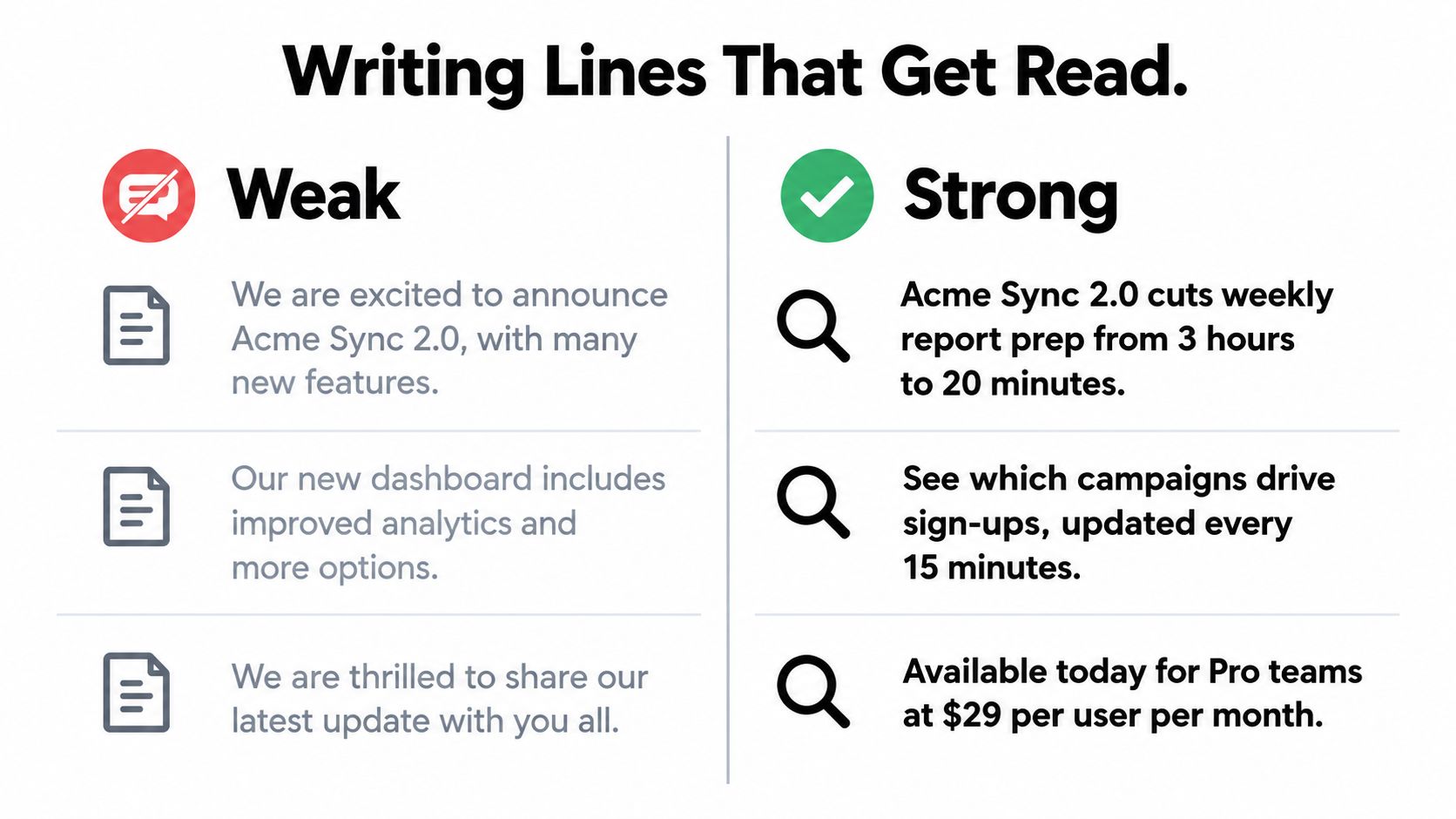
Most launch copy fails in the first line. "We are excited to announce" tells the reader about your feelings, not their problem, and it wastes the only sentence every reader sees. Cut it and start with the outcome.
Compare the pairs below. The weak versions are grammatical, upbeat, and empty. The strong versions name a fact, a date, or a next step.
- Weak: We are excited to announce Acme 2.0 with powerful new features. Strong: Acme 2.0 turns invoice chasing into one click, live March 12.
- Weak: Advanced AI for everyone. Strong: Drafts client follow-ups from your last three emails, for agencies with 10 or more clients.
A headline formula that holds up
Use product, verb, outcome, audience. "Acme drafts client follow-ups for agencies with 10+ clients" works because each part does a job. The verb tells readers what happens, the outcome tells them why they care, and the audience tells them whether it's theirs.
Superlatives without evidence cost you credibility. "Groundbreaking," "powerful," and "effortless" ask readers to take your word for something they can't check. Replace each one with a number, a date, or a named use case, and the line gets shorter and stronger at the same time.
Category framing does the same work at a larger scale. In ABC News coverage of the January 9, 2007 iPhone announcement, Steve Jobs introduced the device at Macworld as a mobile phone, an internet communicator, and a widescreen iPod combined, and it went on sale on June 29, 2007 at a starting price of $499. Readers already understood all three references, so they could repeat the idea without help.
Borrow that structure, not the ambition. "The scheduling tool your team already uses, with client approvals added" gives a reader a familiar category and one new thing. That's easier to pass along than an invented category name nobody can explain in a meeting.
For the formal version of the same message, our guide on how to write a press release that editors can use covers structure and length. When you take the announcement into community threads, these Reddit launch reply tips for founders help you answer questions without turning every reply into a pitch.
Every sentence should name a fact, a reader problem, or the next step. If it does none of those, delete it.
Full Sample Announcement, Filled In
Here's the template assembled into one announcement. The brackets mark every number that must come from your own data. Don't publish with a bracket still in it, and don't fill one with a guess to meet a deadline.
Copyable sample
Headline: Invoice reminders that send themselves, built for freelance designers.
Chasing 40 unpaid invoices a month eats the afternoon you meant to bill. Acme Reminders sends the first three follow-ups on schedule for every open invoice, so you bill more and chase less.
In a pilot of [n] freelance designers over [weeks], manual chasing time fell by [measured %], measured from product analytics. We counted time spent in the invoice screen before and after reminders were switched on for the same accounts.
Available [date] on all paid plans, with a free tier for up to [limit] active invoices.
WCAG 2.2 AA checked on core flows. Video captions are still in progress, due [date].
Start the free trial [UTM-tagged link]
Notice what's missing. There's no founding story, no list of integrations, and no second call to action. Those belong on the product page, where a reader who already cares will go looking for them.
Three edits before you publish
- Remove unsourced superlatives: Search the draft for "best," "fastest," "leading," and "revolutionary." Keep one only if a source or measurement sits next to it.
- Fill every bracket from measured data: Each bracket needs an owner who can show where the number came from, including the cohort size and the period it covers.
- Check the call to action appears once: If you've also asked for a demo booking, a newsletter signup, and a social follow, pick the one that matches your target metric and delete the rest.
I would also read the sample aloud once. Lines that look fine on screen often collapse when spoken, especially the benefit sentence. If you run out of breath, the reader runs out of patience.
One more check matters. Read only the headline, the first sentence, and the call to action. If those three lines still make sense together, skimmers get the full story. If they don't, the middle is carrying weight the opening should carry.
Dated Timeline and Channel Sequence
Launches rarely fail on wording. They fail because nobody owned the link test, the beta results weren't written down, or support heard about the date from a customer. A dated plan with named owners prevents all three.
That's not a high bar, apparently. Forrester's 2024 Portfolio Marketing Survey, published in 2025, found that in 2024 only 25% of portfolio marketers said their organizations had best-in-class product-launch processes.
The four-week sequence
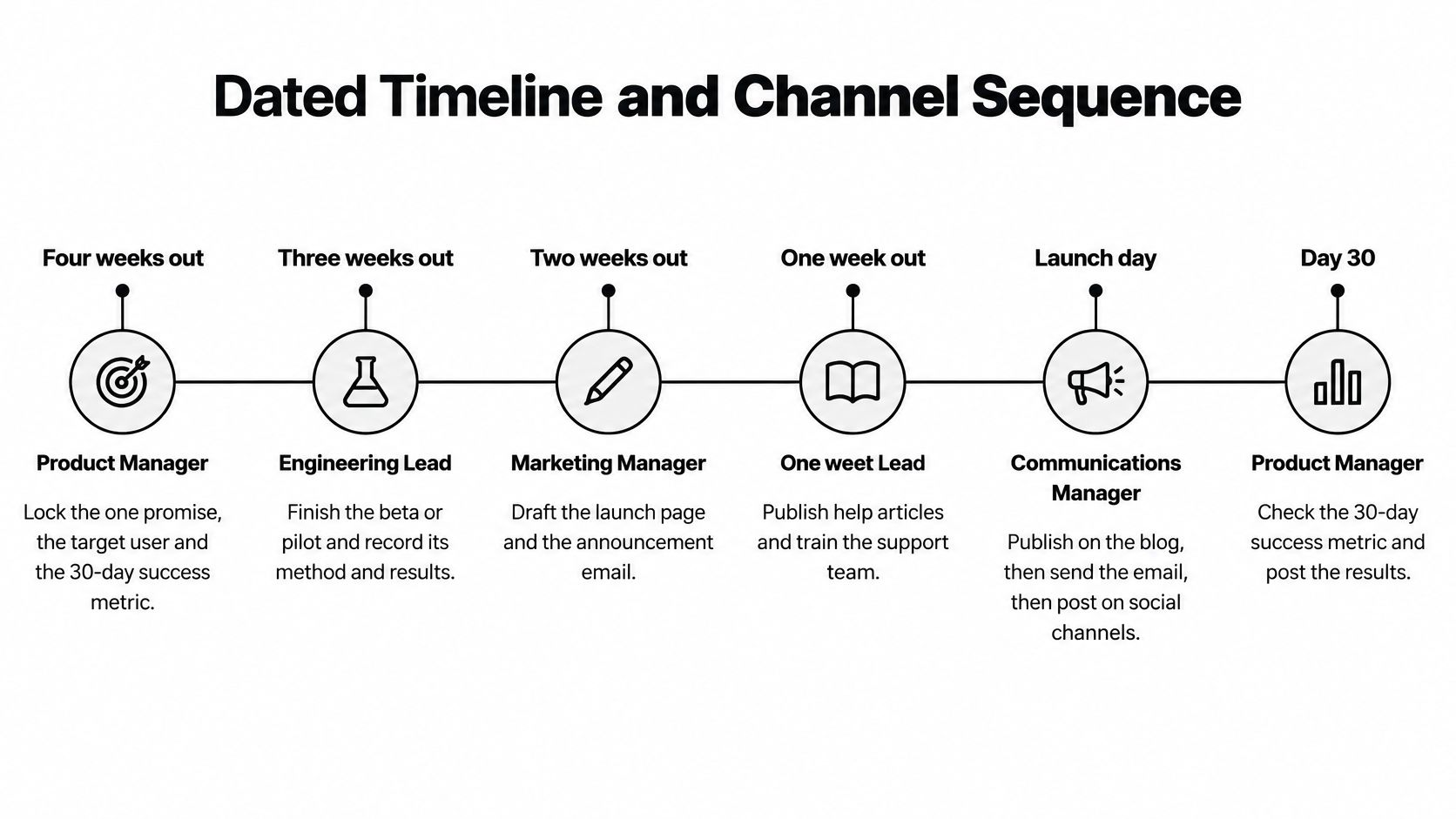
- Four weeks out, product manager: Lock the one promise, the target user, and the 30-day success metric. Write all three in one document everyone can see.
- Three weeks out, engineering lead: Finish the beta or pilot and write the measured result down before anyone drafts copy. Copy written first tends to invent the proof it needs.
- Two weeks out, marketing manager: Draft the announcement, build the launch page, and instrument sign-up, activation, and call-to-action events. Test that the events fire, not just that the code shipped.
- One week out, support lead: Brief support, partners, and sales. Schedule the email and test every link, form, and redirect on a real phone.
- Launch day, communications manager: Publish to owned channels first, then reply to comments within the first few hours while the post is still visible.
If you're launching with us, plan around a fixed window. Our weekly launches start every Monday at 8:00 AM UTC, and all products scheduled for that week go live together. We rank products weekly under Top Projects and Last Week's Best, and monthly under This Month's Best, so your launch week timing affects which lists you're eligible for. Our longer breakdown of building a product launch timeline with owners covers dependencies between these steps.
Send in this order
Write a different version for each channel. The email to existing users can skip the category explanation, while a directory listing has to earn attention from someone comparing six similar tools. For B2B audiences, LinkedIn launch support for B2B startups is a useful reference for shaping posts that read as professional updates rather than ads.
| Channel | Best for | Post when | Main risk |
|---|---|---|---|
| Owned email list | Existing users and trial accounts | Launch morning, follow-up around day 3 | Sending twice to the same people |
| In-app notice or changelog | Active users who will use the feature | Same day as availability | Banner blindness; keep it to one line |
| Partner or integration newsletters | Users of the platform you connect to | About one week before, with a joint offer | Partner calendars fill early |
| Product directories and launch boards | New users browsing by category | Launch day, in weekly or monthly lists | Generic listings get lost among competitors |
| Social posts with a demo clip | Founders, operators and early adopters | Launch morning, then two follow-ups that week | Posts fade fast without follow-ups |
| Press and newsletter outreach | Industry writers and analysts | Five to seven days before, under embargo | Writers ignore generic pitches |
Lead with owned channels because those readers already trust you and will surface broken links fast. Pitch press five to seven days before under embargo with one new data point, since a feature list gives a writer nothing to work with. Partner newsletters need the longest lead because someone else controls that calendar.
Measuring Whether the Launch Worked
Set a baseline before you publish, or you'll end up comparing launch week against nothing. Assign one owner each for acquisition, activation, retention, and revenue, and tag every link so each channel is measured separately. Then split results by channel, audience, geography, and device instead of reading aggregate page views.
Reach is a weak verdict. McKinsey research on product and service launches found that more than 50% of product launches fail to hit their business targets, and found no correlation between the amount invested in a launch and its success rate. Spending more on announcement reach doesn't fix a product that people don't activate.
Read the checkpoints in order
| Checkpoint | Metrics to read | Red flag | Next action |
|---|---|---|---|
| 24 hours | Delivery errors, broken links, sign-up failures | Any error on the launch page or form | Fix it and resend to affected segments |
| 7 days | Qualified visits and activation rate by channel | Traffic rising while activation stays flat | Interview users who did not activate |
| 30 days | Retention, support tickets and revenue quality | Users dropping off in their first week | Ship one fix to the highest-friction step |
| 60 and 90 days | Cohort retention, customer outcomes and reliability | Results that rely only on testimonials | Publish a dated evidence update |
The 24-hour check is purely mechanical. You're looking for delivery errors, broken redirects, and sign-up failures, and any one of them outranks every other conversation that day. Record the measurement window and denominator in every report, or two people will quote the same metric with different numbers.
At 7 days, compare qualified traffic against activation by channel. Traffic rising while activation stays flat points at a mismatch between the promise and the first-run experience, not at a traffic problem. Interview people who signed up and stopped, and ask what they expected to happen next.
A launch-day spike tells you people heard you. Activation and retained usage tell you they believed you and stayed.
At 30 days, read retention and revenue quality, then ship one fix to the highest-friction step and retest the same cohort. Keep impressions, backlinks, and raw sign-ups out of the success decision. Our guide to choosing product launch metrics that predict retention goes deeper on cohort definitions, and I'd publish the 60- and 90-day evidence update on the schedule you announced at launch, even when the numbers are mixed.
Confirm the Checklist and Choose Your Launch Slot
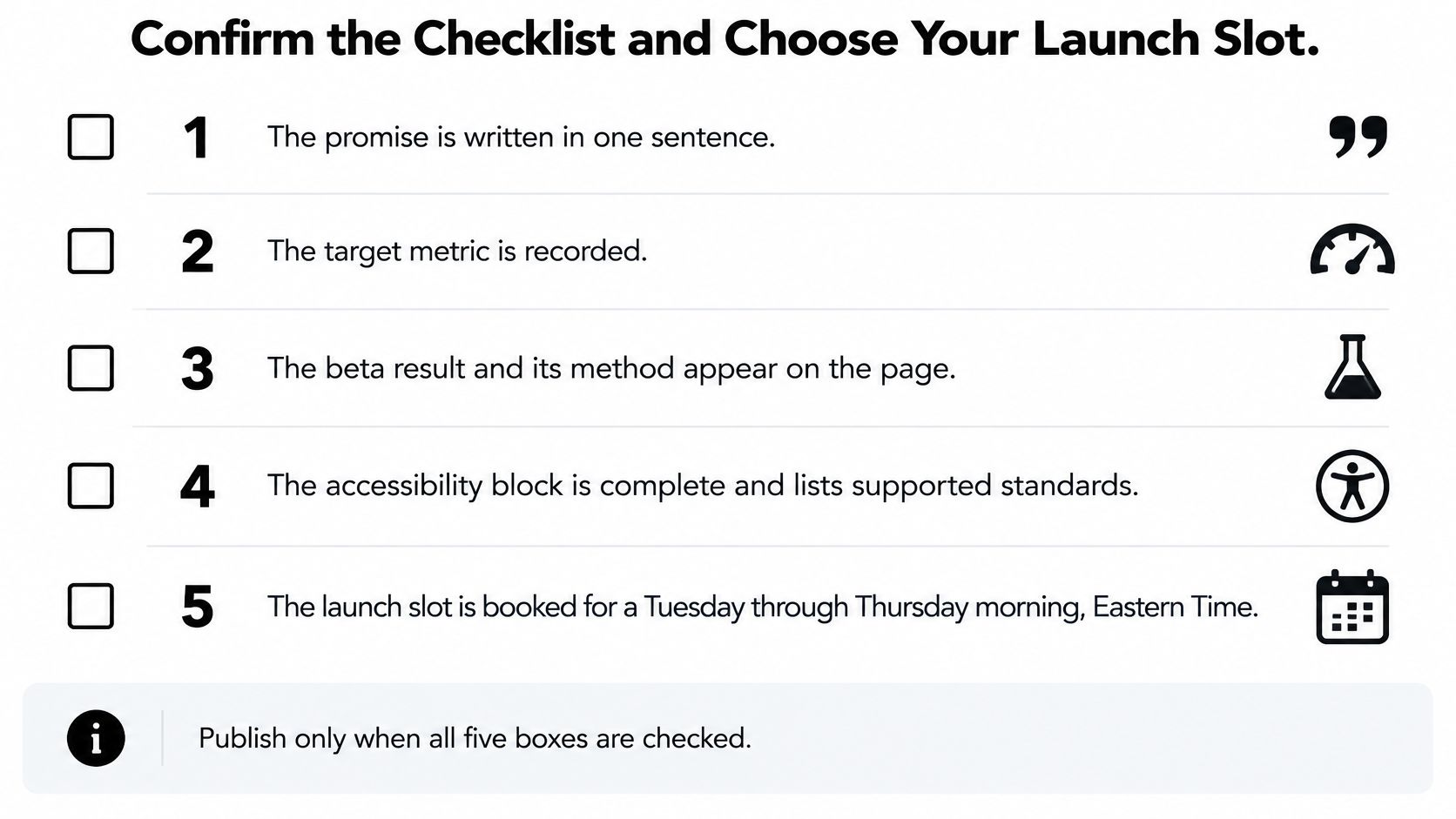
Run this list before anything goes live. If an item fails, the launch moves, because fixing it after publication costs more than a short delay.
- The promise is written in one sentence.
- The target metric is recorded where the team can see it.
- The beta result and its method appear on the page.
- The accessibility block is filled in, including known gaps.
- Every link, form, and redirect is tested on mobile.
- Analytics events fire for sign-up and activation.
- Support knows the launch date and has answers ready.
- The email is scheduled and proofed by someone else.
- The 30-day update is in the calendar with an owner.
If you want a tighter pre-flight pass focused on early traction, a traction-first guide for indie makers pairs well with the list above.
Then pick your slot with us. Our Free Launch costs $0 per launch and lets you choose an available Monday launch with standard placement. Our Premium Launch costs $19 per launch and gives priority placement in an available Monday launch.
Be clear about the backlink. A Free Launch gets a dofollow backlink only if the product ranks in the top 3 weekly and displays the SubmitMySaas badge on its site, so don't plan your launch around it as a guarantee. I would choose the free slot when your owned channels can carry the launch, and the paid slot when the directory listing is your main discovery route. Decide before the one-week mark, since the Monday slot won't move for you.
When your announcement is written, tested, and tied to a metric you can report at 30 days, put it in front of the founders, makers, and early adopters who browse new SaaS and AI tools each week. Choose a Monday launch slot, publish with standard or priority placement, and let your listing compete for weekly and monthly rankings at SubmitMySaas.